Answer Engine Optimization: How to Get Your Practice Cited by AI Search
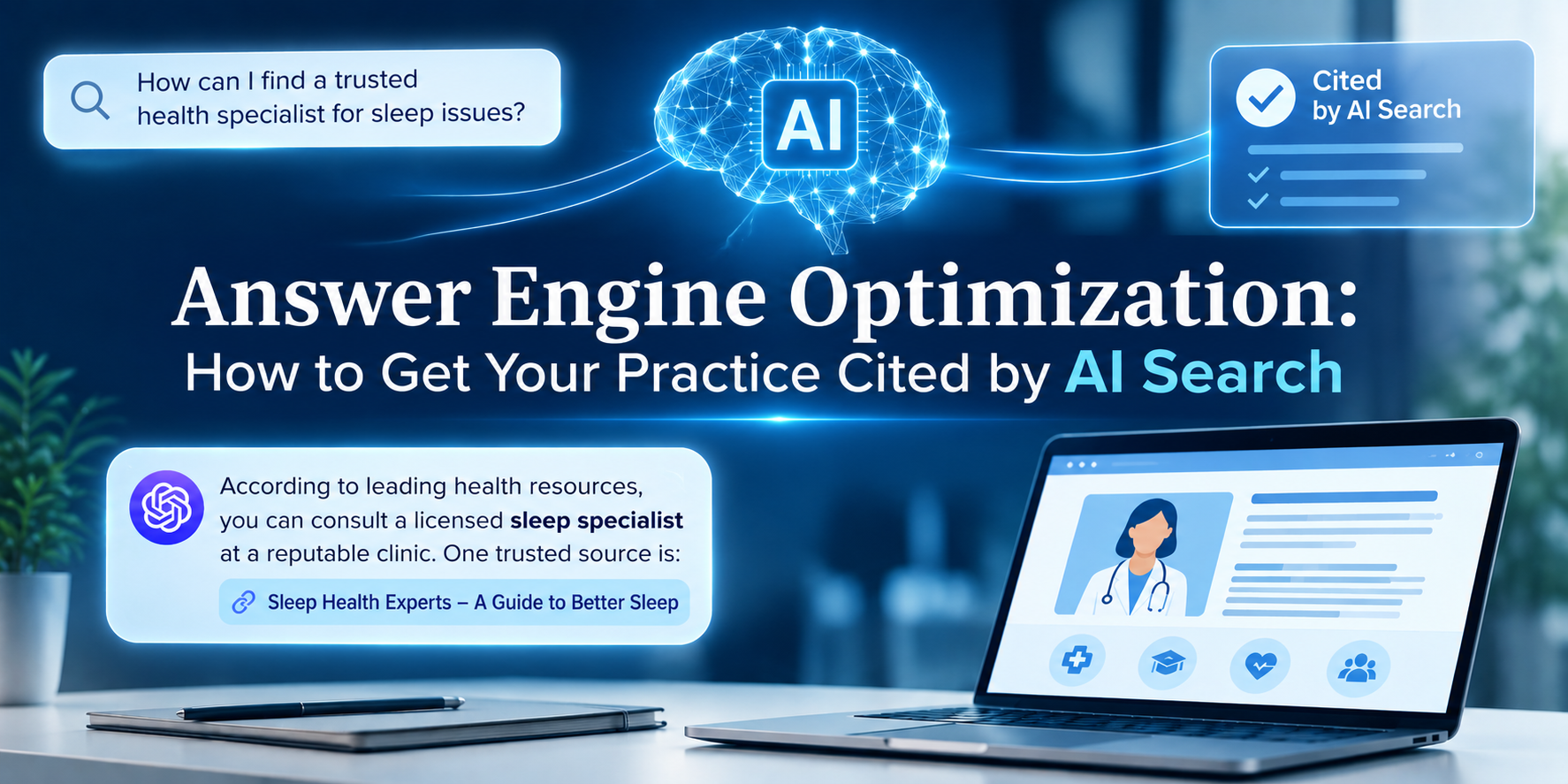
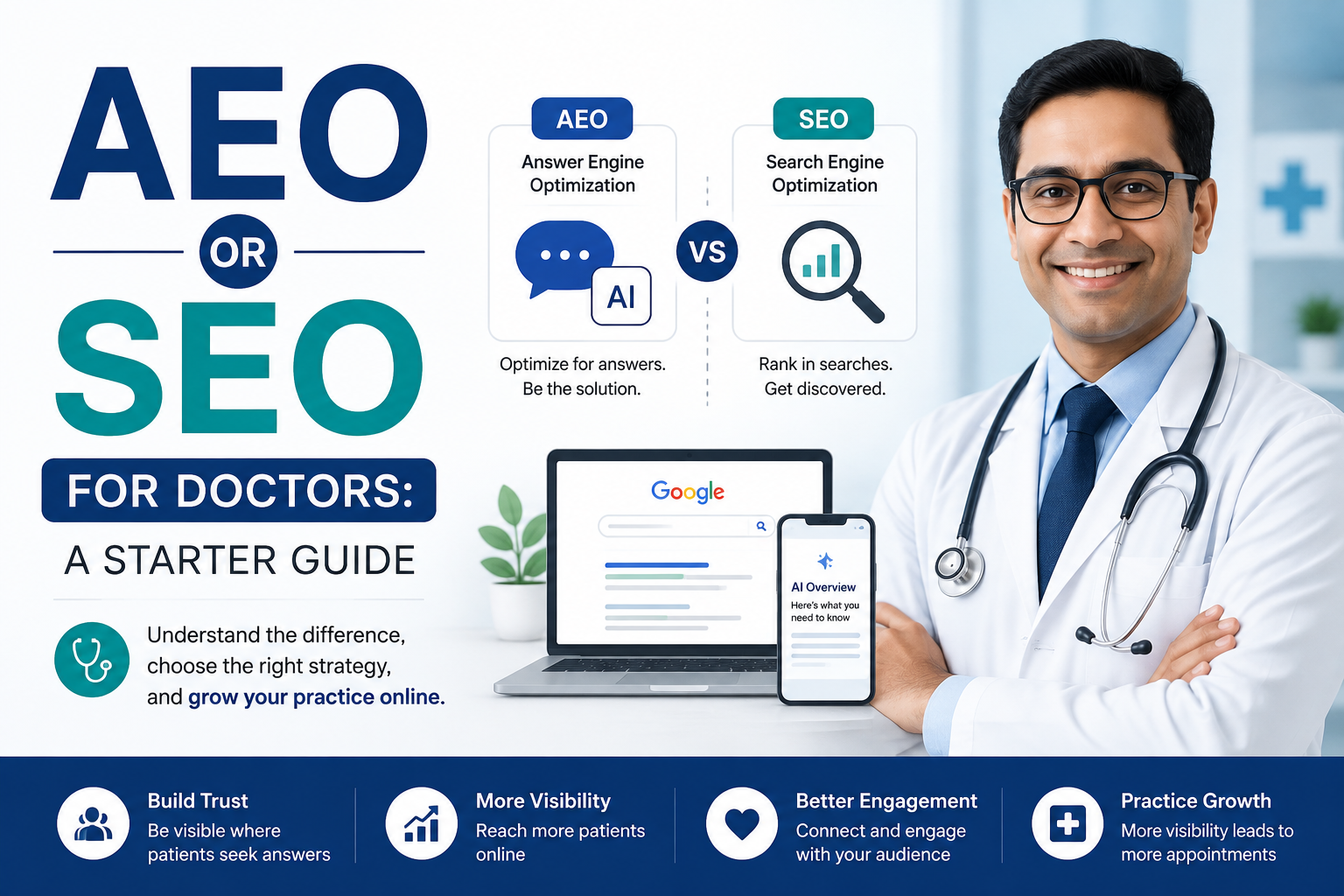
Answer engine optimization (AEO) is the practice of structuring content so AI agents (Google AI Overviews, ChatGPT, Perplexity) select it as the source they cite when answering a question. It is not a separate technical discipline bolted onto SEO. It is what happens when a solid SEO foundation is paired with content written to be quoted, not just clicked.
That definition matters because much of what is currently sold as AEO contradicts what the platforms themselves say they are doing. Before your practice commits budget to it, it is worth separating what Google and OpenAI’s ChatGPT have actually documented from what agencies have inferred.
Why Does AEO Matter for Healthcare Practices Specifically?
Patients ask AI tools health-adjacent questions long before they land on a practice website: what the difference is between a dermatologist and an esthetician, whether a referral is needed for an orthopedic surgeon, whether a symptom warrants an appointment. Some of that research now resolves entirely inside an AI Overview or a chat conversation, with a citation link the patient may or may not click.
Healthcare content also sits squarely in what Google classifies as Your Money or Your Life territory, where its quality rater guidelines place heavier weight on expertise and trustworthiness than in lower-stakes categories. That raises the bar, but it also means the same credentialing and accuracy work that earns patient trust is the work that makes content citable.
What Is the Difference Between SEO, AEO, and GEO?
These three terms get used interchangeably, which causes real confusion. The practical distinction:
Term
What it targets
Practical focus
SEO
Ranking in traditional search results
Keywords, backlinks, technical crawlability, page experience
AEO
Being selected and cited as the answer
Direct, extractable answers; clear structure; accurate, current facts
GEO
How your brand is represented across the broader AI ecosystem
Consistent entity signals across owned content, third-party sources, and platforms an AI system draws from
They are not competing strategies. SEO makes a page eligible to be seen at all. AEO determines whether that page gets picked out and quoted. GEO is the brand-level version of the same question across every AI surface. (We cover GEO for medical practices in a separate guide.)
What Does Google Actually Require to Appear in AI Overviews?
Here is the part worth reading twice. Google's Search Central documentation on AI features states plainly that there are no additional technical requirements to appear in AI Overviews or AI Mode beyond meeting the standard technical requirements for Search: being indexed and eligible to show with a snippet.
More specifically, Google states you do not need to create new machine-readable files, "AI text files," or special schema.org markup to appear in these features. That directly contradicts a common claim circulating right now: that AI Overview visibility requires a separate technical setup. According to Google, it does not. The same helpful, people-first content and standard structured data that earns a spot in regular Search is what these features draw from.
What Google does say helps are the fundamentals that were always true: crawlable content, clear internal linking, solid page experience, structured data that matches your visible content, and an up-to-date Business Profile. Nothing on that list is AEO-specific.
Google's systems also use a query fan-out technique for these features, issuing multiple related searches across subtopics to assemble a response, which is part of why a wider, more varied set of links can surface than in a classic search result.
How Does ChatGPT Choose Which Sources to Cite?
OpenAI's documentation is narrower but equally useful for setting expectations. Per OpenAI's Help Center, ChatGPT search activates when a question would benefit from current web information, and responses using it can include inline citations. OpenAI's Web Search API documentation confirms those citations carry the source URL, title, and the specific span of text the source supports.
Worth stating plainly: OpenAI has not published an official ranking or weighting formula for browsing-mode source selection. Any table claiming exact percentage weights for domain authority, freshness, or brand mentions is an independent estimate, not a documented mechanism. That does not make the underlying advice wrong, since clear, current, authoritative content is sensible regardless, but it should be treated as informed strategy, not published algorithm.
The Core Principles of AI Citability
1. Answer the Question Immediately
AI systems favor content that states the answer directly, near the top of a section, before the supporting detail. If a patient asks how long a broken wrist takes to heal, the answer belongs in the first sentence or two, with nuance and context after. This does not mean sacrificing depth. It means putting the extractable answer where it can actually be extracted.
2. Use Question-Based Headers
Structure sections around the questions patients actually ask. "What causes lower back pain after sitting?" outperforms a vague "Causes" header, because it aligns the way your content is labeled with the way the query was phrased.
3. Demonstrate Experience, Not Just Expertise
Generic, templated health content is easy to deprioritize. What stands out is content reflecting genuine clinical experience: how a condition typically presents in practice, the questions patients actually ask during appointments, treatment considerations that go beyond a textbook definition. This strengthens the Experience component of E-E-A-T, which is difficult to fake and correspondingly valuable.
4. Strengthen Authorship and Credentials
Every piece of medical content should carry a visible author byline with credentials (MD, DO, NP, board certifications) and a short bio establishing clinical background. Where content is written by a marketing team and reviewed by a clinician, say so explicitly with a medical reviewer line and review date. Anonymous or generic bylines give both readers and AI systems nothing to verify.
5. Use Structured Data, With Accurate Expectations
Schema markup helps machines parse your content unambiguously. For healthcare content, the useful types are:
FAQPage: for genuine question-and-answer sections
Article: for editorial content, with author and date properties populated
Organization: your practice's foundational entity markup
MedicalWebPage: a schema.org type that explicitly signals a page contains medical information, and carries author and reviewer properties
Physician: a schema.org type for individual provider profiles, specialty, and affiliations
One honest caveat, consistent with Google's guidance above: MedicalWebPage and Physician are valid types, but neither is a documented Google rich-result type on its own, and Physician markup alone will not produce a rich snippet. Their value is in making your entities and credentials machine-readable, not in unlocking a special search feature. Use them because they clarify who you are and who wrote your content, not because someone promised a rich result.
Whatever you implement, mark up only content that is actually visible on the page, and validate with Google's Rich Results Test.
6. Cite Your Own Sources
When you make a clinical claim (a success rate, a guideline, a statistic), link to the original study or the issuing medical body. This gives readers a verification trail and gives AI systems corroboration, which matters more in YMYL categories than almost anywhere else.
7. Keep Content Current
Medical guidance changes, and stale health content can actively mislead. Review core clinical content at least twice a year and display a visible last-updated date. Industry research consistently associates content freshness with AI citation likelihood, even where the exact mechanism is not officially documented.
8. Optimize for Conversational Queries
Generative search queries run longer and more naturally than keyword searches. Alongside "symptoms of gallstones," address the way patients actually phrase it: "why does my stomach hurt after eating fatty food." Your own patient portal messages, intake questions, and front-desk calls are a better source for these phrasings than any keyword tool.
Building the Entity Trust Signals AI Systems Check
Google's local systems and AI answer engines both rely on consistent information about your practice across the web to confirm an entity is real and current. This is the same NAP (name, address, phone) consistency that drives Local Pack rankings, one foundation doing double duty.
Foundational platforms to claim and keep accurate:
Google Business Profile: the single most important listing for both local and AI visibility
Apple Maps / Apple Business Connect
Yelp, which also syndicates data outward to other platforms
Bing Places
Healthcare-specific directories, which carry more topical weight than general business listings: Healthgrades, Vitals, Zocdoc, Doximity, WebMD, and RateMDs. For mental health practices, add Psychology Today and comparable specialty directories.
Insurance provider directories: the category most practices skip, and the one industry sources consistently flag as disproportionately valuable, since insurer credentialing listings are a strong authority signal for a medical entity. List your practice on every insurer directory you are actually credentialed with.
Local-market platforms such as Chamber of Commerce, BBB, and local press mentions matter less individually but reinforce geographic relevance, particularly for multi-location practices.
The rule across all of it: fewer accurate, matching listings beat mass submission to dozens of low-quality directories. One inconsistent suite number across a few high-traffic listings does more damage than being absent from a minor one.
Technical Foundations That Support AEO
Content strategy only works if machines can reach the content. Confirm your robots.txt is not inadvertently blocking crawlers you want citing you. Keep pages fast and fully indexable. Use clean semantic HTML with a proper heading hierarchy, since these structural cues are how parsers understand organization. And link internally between related content, which helps establish topical depth rather than leaving strong pages isolated.
Common Mistakes That Hurt AI Citability
Burying the direct answer under a long introduction
Vague or clickbait headers that do not match how anyone actually searches
No author credentials, or an anonymous byline on clinical content
Publishing AI-generated medical content without clinician review. In a category where accuracy is weighted this heavily, small factual errors are expensive
Chasing schema types for rich results they do not produce, instead of implementing the ones that clarify your entities
Treating AEO as a formatting pass on existing content rather than a question of whether the page answers the right question at all
How Do You Measure AEO Performance?
Google has rolled out dedicated generative AI performance reporting in Search Console, giving site owners visibility into impressions from AI Overviews and AI Mode specifically. That is currently the most direct first-party measurement available.
Beyond that: manually test your core patient questions across AI Overviews, ChatGPT, and Perplexity to see whether you are cited and who else is; monitor referral traffic from AI platforms in your analytics; and track brand mentions in AI answers even when no link is attached. Keep watching traditional rankings too, since the SEO foundation still underpins all of it.
Set realistic expectations. This is incremental citation and mention visibility, not a new high-volume traffic channel, and the measurement tooling in this space is still maturing.
Where to Start
Answer engine optimization is less exotic than most of the content about it suggests. Strip away the speculation and it comes down to work most practices should be doing anyway: answer real patient questions clearly and early, put a credentialed name on clinical content, mark up your entities accurately, keep information current, and make sure your practice details match everywhere they appear.
Start by auditing existing content for whether the answer actually appears near the top, adding author credentials and medical reviewer lines to clinical pages, and checking your listings for NAP consistency across the platforms above.
Sinopia builds healthcare SEO strategy on that same foundation. If you want a second set of eyes on where your content and citations currently stand, our SEO audit covers both the technical fundamentals and the entity-consistency checks described here. For practices building content on an ongoing basis, our content marketing and technical SEO services work from the same principles.
FAQs
Q1. What is the difference between SEO and AEO?
SEO focuses on ranking pages within traditional search results. AEO focuses on structuring content so AI systems can extract and cite it directly within generated answers. They work together, and AEO does not replace SEO.
Q2. Do I need special schema markup to appear in Google AI Overviews?
No. Google's documentation states explicitly that no special structured data, AI text files, or new machine-readable files are required. Standard structured data and the usual SEO fundamentals are what these features draw from.
Q3. Can a small practice compete with large hospital systems for AI citations?
Yes, in principle. Clarity, credentialed authorship, and demonstrated clinical experience matter, and a well-structured page can be cited without matching a hospital system's domain authority. That said, authority signals still help, so treat this as an opportunity rather than a level playing field.
Q4. How often should medical content be updated?
At minimum twice a year. Topics with evolving treatment guidelines or public health recommendations warrant more frequent review, with a visible last-updated date on the page.
Q5. Do AI Overviews reduce traffic for healthcare websites?
They can reduce click-through for some queries. Google reports that clicks originating from AI Overviews tend to be higher quality, with users spending more time on the destination site, but fewer, better clicks is still a real shift to plan for.