
 Healthcare SEO
  PPC & Google Ads
  Website Design
  Content Marketing
 Reputation Management
 Digital Marketing
Master the Patient Journey and Increase Appointment Bookings
Patients rarely book after a single website visit. Healthcare practices need a clear journey that turns initial research into trust, engagement, and ultimately a booked appointment.

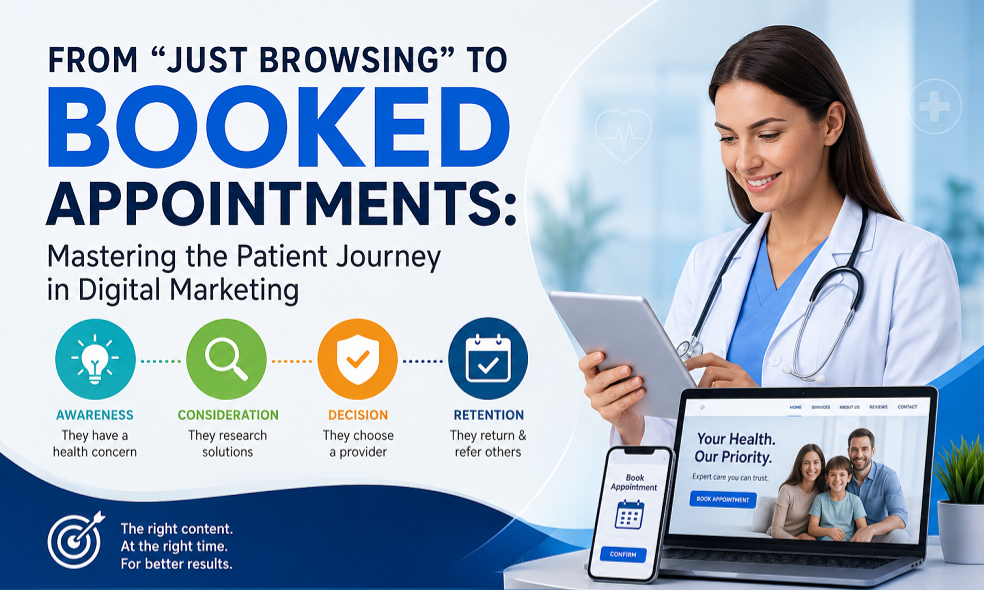
Moving patients from browsing to booking requires more than driving website traffic. Practices need clear treatment information, strong trust signals, easy appointment options, timely follow-ups, and a frictionless patient journey that supports every stage from first search to scheduled visit.
If you run a medical clinic or a healthcare business in the USA, you know that the “old way” of getting patients is fading. Referrals are great, but in 2026, the first place a person goes when they feel a sharp pain in their knee or decide it’s time for a skin check isn’t the phone it’s Google. That’s why investing in professional digital marketing services for healthcare has become essential for clinics looking to attract and retain patients online.
However, most healthcare providers make a critical mistake: they treat digital marketing like a digital yellow pages. They think a website is just a static billboard. In reality, your digital presence must be a map that guides a stranger through a complex emotional and logical process. This process is the Understanding Patient Journey in Digital Marketing.
However, most healthcare providers make a critical mistake: they treat digital marketing like a digital yellow pages. They think a website is just a static billboard. In reality, your digital presence must be a map that guides a stranger through a complex emotional and logical process. This process is the Patient Journey in Digital Marketing.
In this guide, we’ll break down how to align your marketing with the way modern patients actually think and behave. At Sinopia, we’ve seen that clinics that master this journey don’t just get more clicks they get more high value, loyal patients.
What is the Patient Journey in Digital Marketing?
In digital marketing, this isn’t a straight line. It is a series of digital touchpoints including search engine results, social media posts, website landing pages, and email follow-ups.
The post focuses on the patient journey and conversion process rather than presenting a specific client-performance statistic.
The Four Stages of the Journey
- Awareness: The patient realizes they have a symptom or need (e.g., “Why is my back hurting?”).
- Consideration: The patient researches solutions and compares providers (e.g., “Physical therapy vs. chiropractor in Houston”).
- Decision: The patient chooses a provider and looks for proof (e.g., “Best reviewed cardiologist near me”).
- Retention: The patient has visited the clinic and needs a reason to stay or refer others.
Direct Answer: Understanding the patient journey means mapping your content to specific psychological stages so you provide the right information at exactly the right time.
Why It Matters for Businesses (USA Focus)
For a business owner in the competitive US healthcare market, ROI is everything. You aren’t just competing with the clinic down the street; you’re competing with massive hospital networks and national telehealth brands.
1. Increased Conversion Rates
2. Lower Patient Acquisition Cost (PAC)
By targeting informational searches earlier in the funnel, you can reach patients before competitors focus on them, often at a significantly lower advertising cost.
3. Better Patient Experience and E-E-A-T
💡 Quick Audit: Is your website answering patient questions or simply listing services? If you’re not sure, request a free SEO audit from Sinopia.
Common Problems: Where Most Clinics Lose Patients
The "Me, Me, Me" Syndrome
The "Friction" Trap
If patients must complete lengthy forms or navigate a confusing booking process, many will leave before scheduling.
Ignoring the Research Phase
Lack of Mobile Optimization
Step-by-Step Guide: Strategies for Every Stage
To master the Patient Journey in Digital Marketing, you need a multi-layered approach.
1. The Awareness Stage (Educational SEO)
- Strategy: Create symptom-first educational content.
- Example: “5 Signs Your Foot Pain Is Actually Plantar Fasciitis.”
- Action Step: Target long-tail keywords beginning with How, Why, and What.
2. The Consideration Stage (Comparison & Trust)
- Strategy: Create comparison guides, videos, and educational resources.
- Example: “Non-Surgical vs. Surgical Options for Knee Pain.”
- Action Step: Offer downloadable guides or preparation checklists in exchange for email signups.
3. The Decision Stage (Conversion Optimization
- Strategy: Showcase reviews, office photos, insurance information, and provider expertise.
- Action Step: Place a prominent “Book Online” button above the fold on every page.
4. The Retention Stage (Email & Remarketing)
- Strategy: Use automated follow-up emails and ongoing patient communication.
- Action Step: Send monthly newsletters featuring seasonal healthcare reminders and wellness tips.
Need help implementing this strategy? Schedule a free consultation with the Sinopia healthcare marketing team today.
Pro Tips: Advanced Agency Insights
Semantic SEO & Entity Building
Google evaluates topical relevance and relationships between concepts, not just keywords. Create comprehensive content ecosystems around your specialty.
Local SEO Is the Backbone
Your Google Business Profile can be more influential than your homepage for local patient acquisition. Maintain consistent NAP information everywhere online.
AI-Driven Patient Support
HIPAA-compliant AI chat tools can provide immediate answers to common questions and improve patient engagement.
Zero-Click Content
Key takeaways
- Make treatment information easy to understand.
- Build trust before asking patients to book.
- Remove friction from appointment booking.
- Follow up with interested patients.
- Optimize every step of the patient journey.
Real-World Example: The Orthopedic Success Story
The Old Strategy
The Sinopia Strategy
- Awareness: Educational injury-treatment content.
- Consideration: Surgery vs. physical therapy comparison resources.
- Decision: Video provider bios and instant online booking.
The Results
Within six months, organic traffic increased by 150%, while cost-per-lead decreased by 60%.
Conclusion: Start Mapping Your Path to Growth
Understanding the Patient Journey in Digital Marketing is the difference between a website that simply exists and one that actively generates new business.
By aligning content with Awareness, Consideration, Decision, and Retention stages, you create a seamless experience that transforms curious searchers into loyal patients.
At Sinopia, we use advanced tactics to give our clients an edge in the US market. Whether you’re investing in healthcare SEO, local search optimization, or content marketing, these strategies can help your practice stay ahead of competitors.
You aren’t simply selling healthcare services you are providing a trusted path to wellness.
Frequently asked questions
Q1. How long does it take to see results from patient journey mapping?
Most content-driven strategies show significant organic growth within 3 to 6 months, while optimized paid campaigns may produce results much sooner.
Q2. Is this strategy HIPAA compliant?
Yes, provided your forms, appointment booking tools, and communication systems are HIPAA compliant and properly protect PHI.
Q3. Do I need a huge budget to compete with big hospitals?
No. Local clinics can often outperform larger organizations by targeting specific local needs and delivering a more personalized experience.