
 Healthcare SEO
 PPC & Google Ads
 Website Design
 Content Marketing
 Reputation Management
Digital Marketing
The "Invisible" Patient: How to Win New Patients in the Era of Zero-Click Searches

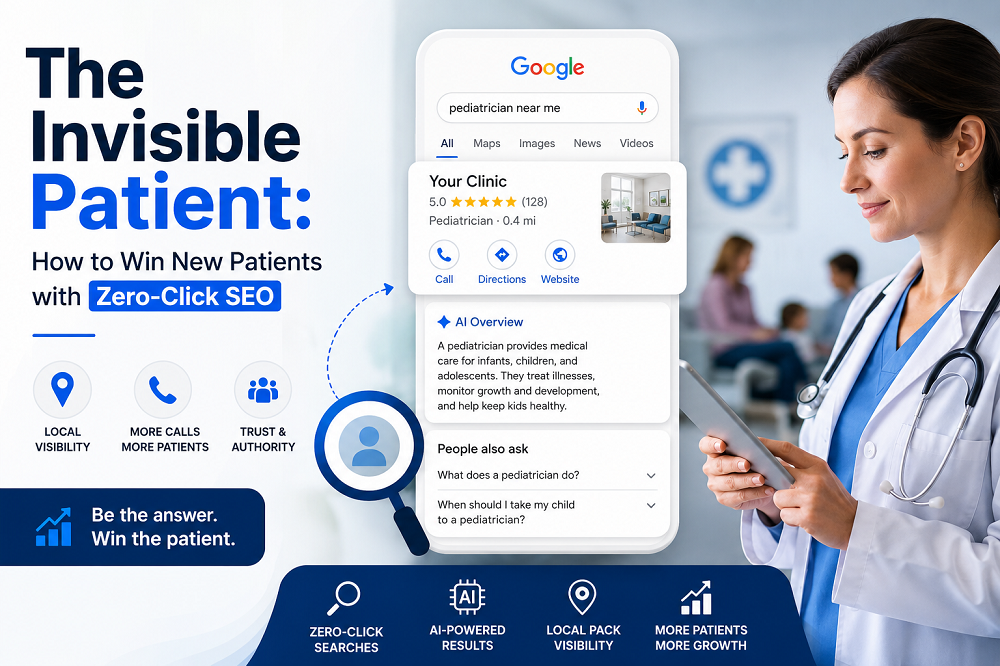
If you are a clinic owner or a healthcare provider in the USA, you’ve likely noticed something strange. Your website traffic might be dipping or staying flat, yet your phone is still ringing—or perhaps it’s not ringing as much as it used to despite your SEO efforts.
In the current digital landscape, over 57% of mobile searches and nearly 43% of desktop searches end without a single click to a website.
In this comprehensive guide, we’ll dive deep into what Zero-Click Searches mean for your medical practice, why the old SEO rules are breaking, and the exact roadmap Sinopia uses to ensure our healthcare clients stay profitable when Google tries to keep all the traffic for itself. We’ll also explain why modern healthcare SEO is no longer just about rankings—it’s about visibility everywhere patients search.
What is a Zero-Click Search? (The Beginner's Guide)
Think about the last time you searched for “Pediatrician near me” or “What are the symptoms of Strep Throat?“
- A Google Business Profile with a phone number and address.
- An AI Overview (formerly SGE) summarizing the symptoms.
- A “People Also Ask” dropdown menu.
If you found the phone number or the answer right there, you didn’t need to click a website. That is a zero-click search.
For clinics, this means your website traffic might decline while your brand impressions, calls, and appointment requests become the new currency of success.
Why Zero-Click Searches Matter for USA Healthcare Businesses
Traffic is becoming a secondary metric. Visibility and search intent are the new kings.
1. The Rise of AI Overviews (SGE)
If someone searches “How long does a Botox treatment last?”, Google’s AI compiles information from trusted sources and answers immediately.
To appear here, your clinic doesn’t just need a website—you need to become the trusted source Google references.
2. Local Intent is Naturally Zero-Click
Healthcare is inherently local.
When someone searches for an urgent care clinic, dentist, or primary care physician, they usually want:
- Directions
- Phone number
- Office hours
- Reviews
- Appointment button
3. Better ROI
Zero-click searches are not bad for business.
A patient calling directly from Google Maps often converts much faster than someone reading multiple blog posts before making a decision.
Common Problems Clinics Make
Ignoring Google Business Profile
Many clinics create their listing once and never update it.
If your office hours, photos, services, or phone number are outdated, Google may prioritize competitors with more active profiles.
Focusing on Vanity Metrics
Website traffic alone doesn’t pay the bills.
If your SEO agency celebrates more visits while patient appointments remain flat, they’re measuring the wrong KPI.
Poor Website Experience
If someone actually clicks your website, make it count.
Slow loading pages, confusing navigation, or missing appointment buttons drive users back to Google.
How to Win: A Step-by-Step Strategy
Step 1: Optimize Your Google Business Profile
- Claim and verify your listing.
- Keep your Name, Address, and Phone Number consistent everywhere.
- Upload high-quality photos.
- Publish weekly updates.
- Answer every review.
Step 2: Structure Content for Featured Snippets
- Use question-based H2 and H3 headings.
- Provide concise 40–50 word answers immediately after each question.
- Use bullet points wherever appropriate.
Step 3: Implement Healthcare Schema Markup
Schema markup tells search engines exactly what your content represents.
Healthcare providers should use MedicalBusiness or Physician schema to identify:
- Medical specialties
- Accepted insurance
- Office hours
- Location
- Contact details
Step 4: Target "People Also Ask"
Create FAQ sections for every major service page.
Google frequently pulls answers from structured FAQ content into search results.
Step 5: Invest in Video Content
Short educational videos often rank prominently for healthcare searches.
A one-minute explanation from a physician can outperform traditional written content for many patient questions.
Pro Tips from Sinopia
Build Brand Searches
Encourage patients to search specifically for your clinic instead of generic phrases like “dentist near me.”
Brand searches increase authority and improve visibility across Google’s ecosystem.
Review Velocity Matters
Fresh reviews carry more weight than older ones.
Fifty reviews earned this year often outperform hundreds collected years ago.
Use Entity-Based SEO
Modern AI understands topics, not just keywords.
If you’re a cardiologist, your content should naturally include related entities such as:
- Heart health
- EKG
- Hypertension
- Cardiovascular disease
This helps AI better understand your expertise.
- Not sure whether your clinic appears in Google's Local Pack? Book a free SEO audit with Sinopia and discover exactly what prospective patients see when searching for your services.
Real-World Example: The "Invisible" Pediatrician
The Challenge
A pediatric clinic in Atlanta experienced a 20% drop in organic website traffic over six months.
The Discovery
The Reason
Parents were finding office hours and emergency contact information directly in Google Search and Google Maps.
They no longer needed to visit the clinic’s website.
The Solution
- Optimized Google Business Profile
- Added online appointment booking
- Created FAQ content targeting common pediatric questions
- Improved local SEO signals
Recommended Tools for Healthcare SEO
- Google Search Console – Monitor impressions and clicks.
- Semrush – Track Featured Snippets and keyword visibility.
- Ahrefs – Analyze competitor rankings and backlinks.
- BrightLocal – Monitor local rankings by ZIP code.
- Sinopia Insights – Our proprietary approach to understanding how AI engines evaluate healthcare practices.
Frequently asked questions
Q1. Are zero-click searches bad for my clinic's SEO?
Q2. How do I appear in Google's AI Overviews?
Q3. Do I still need a website?
Q4. What's the most important factor for local SEO?
Q5. Can I measure zero-click performance?
Q6. How long does it take to see results?
Conclusion: Don't Fight the Future—Own It
At Sinopia, we help healthcare organizations build long-term growth strategies that go beyond website traffic. Our data-driven healthcare SEO solutions are designed to improve visibility, strengthen local authority, and attract more high-intent patients.
At Sinopia, we help healthcare organizations build long-term growth strategies that go beyond website traffic. Our data-driven healthcare SEO solutions are designed to improve visibility, strengthen local authority, and attract more high-intent patients.
Ready to Dominate Your Local Market?
Don’t let your clinic become invisible. Become the top answer on Google.
About the authors
Rahul Sharma is a Digital Marketing Specialist and growth strategist focusing on search engine optimization (SEO), generative engine optimization (GEO), and performance marketing. With expertise in organic search, AI search paradigms (AEO), and automated marketing workflows, Rahul writes for Sinopia on building scalable brands and adapting to modern search discovery patterns. His work bridges technical search foundations, user intent, and practical AI applications to help brands establish long-term visibility, trust, and measurable digital growth.