
 Healthcare SEO
  PPC & Google Ads
  Website Design
  Content Marketing
 Reputation Management
 Digital Marketing
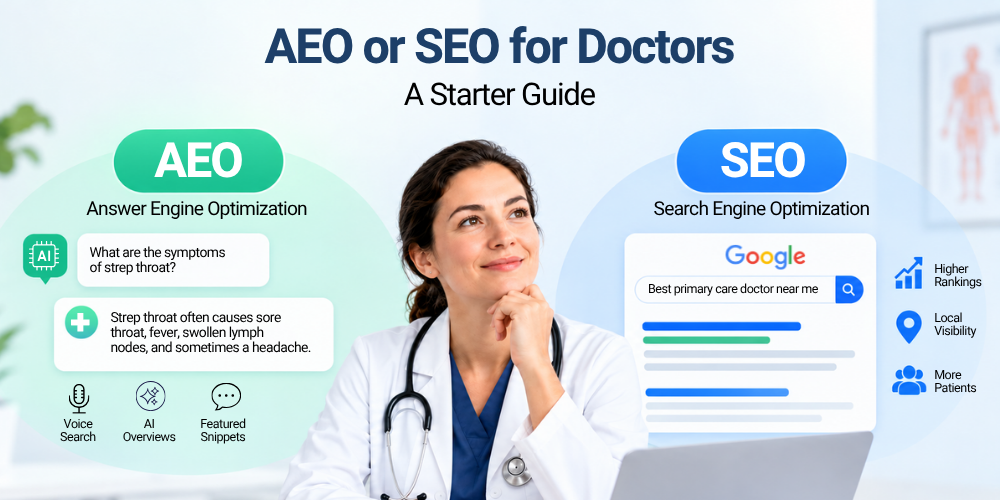
AEO or SEO for Doctors: A Starter Guide

Why Is AEO/SEO Different for Doctors Than for Other Businesses?
Medical content sits in a category Google treats with unusual scrutiny. In its Search Quality Rater Guidelines, Google defines “Your Money or Your Life” (YMYL) topics as those that could significantly affect a person’s health, financial stability, or safety. Health content is the clearest example. Google’s guidance states that pages on clear YMYL topics require the most scrutiny for page quality, and that even minor inaccuracies can cause harm.
What Has Changed in Medical Search for 2026?
Two things, mainly.
First, query behavior. Patients increasingly ask longer, conversational questions rather than short keyword strings. “What should I do if my child has had a fever for three days” instead of “child fever.” That has consequences for how content should be structured, which we cover below.
Second, answers are increasingly delivered inside the search experience itself, through AI Overviews and AI Mode, rather than through a list of links. Google’s documentation on AI features explains that these features use a query fan-out technique, issuing multiple related searches across subtopics to assemble a response. That is part of why a broader mix of sources can appear than in a classic result page.
Worth knowing, since there is a lot of noise on this point: Google states there are no additional technical requirements to appear in AI Overviews or AI Mode beyond the standard technical requirements for Search, and no special schema.org markup is needed for these features. The foundation described in this guide is the foundation. There is no separate AI checklist to buy. (We go deeper on this in our guide to answer engine optimization.)
The Core Pillars of SEO for Doctors
1. Keyword Research Built Around How Patients Actually Search
Patients rarely use clinical terminology. Someone searching “why does my knee hurt when I climb stairs” and someone searching “patellofemoral pain syndrome” may have the identical condition and very different levels of medical literacy. Good content addresses both.
- Condition-based: “symptoms of high blood pressure”
- Treatment-based: “non-surgical options for a herniated disc”
- Local intent: “pediatrician in Atlanta accepting new patients”
- Comparison-based: “physical therapy vs chiropractic care for back pain”
2. On-Page SEO Content That Prioritizes Accuracy Over Keyword Density
Practical priorities:
- Explain conditions in plain language alongside the correct clinical terms.
- Include author bios with real credentials (MD, DO, NP, board certifications).
- Cite peer-reviewed research or established medical bodies when making clinical claims.
- Review and update content as guidelines change, and show a visible last-updated date.
3. Local SEO and Google Business Profile
For most practices, local search drives the majority of actual appointments. A complete, accurate Google Business Profile, with correct hours, services, insurance details, and current photos, often does more for patient volume than any single blog post.
Keep your practice name, address, and phone number identical across your website, your Business Profile, and every directory listing. Inconsistent details confuse both patients and search systems trying to confirm you are a real, current business. The listings worth prioritizing:
- Foundational: Google Business Profile, Apple Business Connect, Yelp, Bing Places.
- Healthcare-specific: Healthgrades, Vitals, Zocdoc, Doximity, WebMD, RateMDs, and Psychology Today for mental health practices.
- Insurance directories: The category most practices skip. List your practice with every insurer you are actually credentialed with.
- Local: Chamber of Commerce, and local press or community mentions.
Accuracy beats volume here. A handful of correct, matching listings outperforms dozens of inconsistent ones. Our local SEO team handles this consolidation work for multi-location practices where the inconsistency problem compounds quickly.
4. Technical Foundations
- Fast load times, particularly on mobile, where most patient searches now happen.
- HTTPS, non-negotiable for any site handling patient information.
- Clean URL structure and logical site architecture.
- Crawlable, indexable pages. A page Google cannot index cannot appear anywhere, including in an AI Overview.
- Structured data that matches your visible content.
On schema specifically, the useful types for medical sites are FAQPage, Article, Organization, and the healthcare-specific MedicalWebPage and Physician types. Be aware that MedicalWebPage and Physician are valid schema.org types but are not documented Google rich-result features. Physician markup alone will not produce a rich snippet. Their value is in making your credentials and entities machine-readable, not in unlocking a search feature. Validate whatever you implement with the Rich Results Test, and only mark up content actually visible on the page. Our technical SEO service covers this end to end.
5. Content That Demonstrates Real Clinical Experience
- Anonymized, HIPAA-compliant case discussions describing how a condition was evaluated and treated.
- The physician’s own perspective on treatment tradeoffs, not a textbook summary.
- Direct answers to the questions patients actually ask in the exam room.
This is the Experience component of E-E-A-T, and it is the hardest of the four for a competitor to copy, because it requires having actually treated the patients. Practices building this out on an ongoing basis often work with a content marketing partner who can interview clinicians and turn that input into publishable material without adding to physician workload.
6. Structure Content So It Can Be Extracted
Related to the above, but distinct. Whether a page gets pulled into a featured snippet or cited in an AI-generated answer depends heavily on whether a clear answer is easy to isolate.
Practical rules: put the direct answer in the first sentence or two of a section, then add nuance. Use question-based headers that match how patients phrase things (“How long does a broken wrist take to heal?” rather than “Recovery”). Keep paragraphs tight. Add a genuine FAQ section where questions are actually questions and answers are self-contained.
7. Authoritative Links, Earned Not Bought
- Contributing expert commentary to health publications or local news.
- Hospital affiliation and medical association listings, where applicable.
- Community health events that generate local press.
- Podcast or interview appearances in your specialty.
Avoid paid link schemes and bulk directory submissions. Google’s link spam policies explicitly cover link buying, and the downside risk is real.
8. Reviews and Reputation
Reviews influence both local ranking and whether a patient who finds you actually calls. A practice with a strong rating and detailed, recent reviews converts better than a competitor with a weak one, largely independent of who has better on-page SEO.
Build a simple, consistent process for requesting reviews after appointments, and respond to all of them, including critical ones. Responding professionally to a negative review is often more persuasive to a prospective patient than the positive reviews around it.
One compliance note that catches practices out: responding publicly to a patient review can acknowledge a treatment relationship, which raises HIPAA considerations. Keep public responses generic and move specifics to a private channel. Our reputation management service is built around that constraint.
Key takeaways
- Build around real patient questions.
- Show physician credentials and sources.
- Keep Google Business Profile and listings accurate.
- Structure content for direct answers.
- Treat SEO as an ongoing process.
A Starter Checklist
- Audit your site for speed, mobile usability, HTTPS, and indexability.
- Claim and fully complete your Google Business Profile.
- Fix NAP inconsistencies across all existing listings before adding new ones.
- Add credentialed author bios, and a medical reviewer line on clinical content.
- Research patient-intent keywords using real patient language.
- Publish experience-based content on a consistent schedule, prioritizing depth over volume.
- Implement and validate schema markup.
- Build a repeatable review request process.
- Track results in Google Search Console, including the AI Overview impression data now available there.
Common Mistakes Doctors Make With SEO
- Treating SEO as a one-time project rather than an ongoing process.
- PPublishing AI-generated medical content without clinician review, which introduces accuracy risk in exactly the category where accuracy is scrutinized most.
- Chasing national rankings that never convert into local appointments.
- Neglecting mobile, where most patient search now happens.
- Buying schema or “AI optimization” packages promising rich results that the underlying markup does not actually produce.
- Letting listings drift out of date after the initial setup.
Where to Start
Start with the checklist above. Most practices find the highest-leverage fixes are the least glamorous ones: correcting inconsistent listings, adding author credentials to existing pages, and making sure the answer to each page’s core question appears in the first paragraph rather than the fifth.
If you want an outside read on where your practice currently stands, Sinopia’s SEO audit covers the technical foundation, content quality, and listing consistency described here. You can also explore our full approach to healthcare SEO, or see how this works for specific specialties including dental, dermatology, and primary care practices.
Frequently asked questions
Q1. How long does SEO for doctors take to show results?
Most practices see measurable movement in local rankings within three to six months, with competitive organic terms taking longer, often six to twelve. This is a general expectation based on typical agency experience rather than a figure published by Google, and it varies considerably with your market’s competitiveness and your site’s starting condition.
Q2. Is medical SEO actually different from regular SEO?
Q3. Do I need a blog if I already have a website?
Q4. Do I need special markup or an "AI optimization" package to appear in AI Overviews?
Q5. How important are patient reviews for local rankings?
Very. Reviews influence local pack visibility and heavily influence whether a patient contacts you at all. Detailed reviews that mention specific conditions or treatments also reinforce what your practice actually does.
Q6. Can I handle this in-house or do I need an agency?
Business Profile optimization and review requests are realistic to run in-house. Technical SEO, schema implementation, and sustained content production usually are not, mostly because they require time clinicians do not have. The honest test is whether someone on your team owns this weekly. If not, it will drift.
Rahul Sharma is a Digital Marketing Specialist and growth strategist focusing on search engine optimization (SEO), generative engine optimization (GEO), and performance marketing. With expertise in organic search, AI search paradigms (AEO), and automated marketing workflows, Rahul writes for Sinopia on building scalable brands and adapting to modern search discovery patterns. His work bridges technical search foundations, user intent, and practical AI applications to help brands establish long-term visibility, trust, and measurable digital growth.