
 Healthcare SEO
  PPC & Google Ads
  Website Design
  Content Marketing
 Reputation Management
 Digital Marketing
Answer Engine Optimization: How to Get Your Practice Cited by AI Search
AI search is changing how patients discover healthcare practices. AEO helps practices structure accurate, expert-led content so AI systems can understand, extract, and cite it.

AEO does not replace SEO. Healthcare practices need strong technical SEO, clear answers, credentialed authorship, accurate local listings, credible sources, and regularly updated content to improve their chances of being cited by AI search systems.
That definition matters because much of what is currently sold as AEO contradicts what the platforms themselves say they are doing. Before your practice commits budget to it, it is worth separating what Google and OpenAI’s ChatGPT have outlined versus actually what so-called experts have inferred.
Why Does AEO Matter for Healthcare Practices Specifically?
Healthcare content also sits squarely in what Google classifies as YMYL territory, where its quality rater guidelines place heavier weight on expertise and trustworthiness than in lower-stakes categories. That raises the bar, but it also means the same credentialing and accuracy work that earns patient trust is the work that makes content citable.
The post does not provide a specific client-performance statistic. It highlights that Google now provides AI Overview and AI Mode performance reporting in Search Console, giving practices a way to monitor AI-search visibility.
What Is the Difference Between SEO, AEO and GEO?
Term | What it targets | Practical focus |
SEO | Ranking in traditional search results | Keywords, backlinks, technical crawlability, page experience |
AEO | Being selected and cited as the answer | Direct, extractable answers; clear structure; accurate, current facts |
GEO | How your brand is represented across the broader AI ecosystem | Consistent entity signals across owned content, third-party sources, and platforms an AI system draws from |
What Does Google Actually Require to Appear in AI Overviews?
Here is the part worth reading twice. Google’s Search Central documentation on AI features states plainly that there are no additional technical requirements to appear in AI Overviews or AI Mode beyond meeting the standard technical requirements for Search: being indexed and eligible to show with a snippet.
What Google does say helps are the fundamentals that were always true: crawlable content, clear internal linking, solid page experience, structured data that matches your visible content, and an up-to-date Business Profile. Nothing on that list is AEO-specific.
Google’s systems also use a query fan-out technique for these features, issuing multiple related searches across subtopics to assemble a response, which is part of why a wider, more varied set of links can surface than in a classic search result.
How Does ChatGPT Choose Which Sources to Cite?
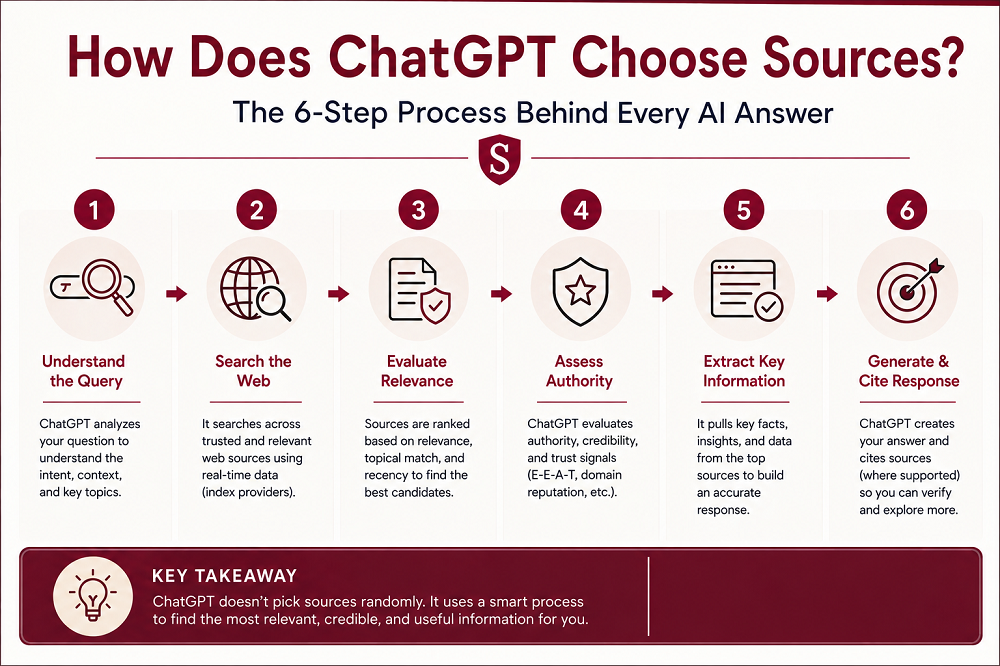
OpenAI’s documentation is narrower but equally useful for setting expectations. Per OpenAI’s Help Center, ChatGPT search activates when a question would benefit from current web information, and responses using it can include inline citations. OpenAI’s Web Search API documentation confirms those citations carry the source URL, title, and the specific span of text the source supports.
Worth stating plainly: OpenAI has not published an official ranking or weighting formula for browsing-mode source selection. Any table claiming exact percentage weights for domain authority, freshness, or brand mentions is an independent estimate, not a documented mechanism. That does not make the underlying advice wrong, since clear, current, authoritative content is sensible regardless, but it should be treated as informed strategy, not published algorithm.
The Core Principles of AI Citability
1. Answer the Question Immediately
2. Use Question-Based Headers
3. Demonstrate Experience, Not Just Expertise
Generic, templated health content is easy to deprioritize. What stands out is content reflecting genuine clinical experience: how a condition typically presents in practice, the questions patients actually ask during appointments, treatment considerations that go beyond a textbook definition. This strengthens the Experience component of E-E-A-T, which is difficult to fake and correspondingly valuable.
4. Strengthen Authorship and Credentials
5. Use Structured Data, With Accurate Expectations
Schema markup helps machines parse your content unambiguously. For healthcare content, the useful types are:
- FAQPage: For genuine question-and-answer sections.
- Article: For editorial content, with author and date properties populated.
- Organization: Your practice’s foundational entity markup.
- MedicalWebPage: a schema.org type that explicitly signals a page contains medical information, and carries author and reviewer properties.
- Physician: a schema.org type for individual provider profiles, specialty, and affiliations.
One honest caveat, consistent with Google’s guidance above: MedicalWebPage and Physician are valid schema.org types, but neither is a documented Google rich-result type on its own, and Physician markup alone will not produce a rich snippet. Their value is in making your entities and credentials machine-readable, not in unlocking a special search feature. Use them because they clarify who you are and who wrote your content, not because someone promised a rich result.
Whatever you implement, mark up only content that is actually visible on the page, and validate with Google’s Rich Results Test.
6. Cite Your Own Sources
7. Keep Content Current
8. Optimize for Conversational Queries
Building the Entity Trust Signals AI Systems Check
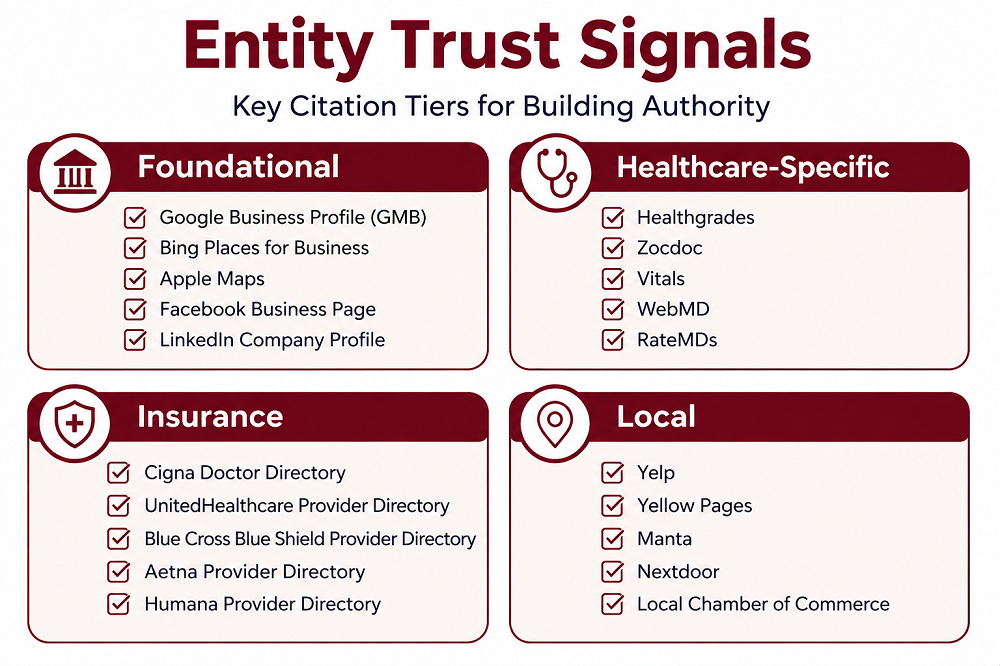
- Google Business Profile: the single most important listing for both local and AI visibility.
- Apple Maps / Apple Business Connect.
- Yelp, which also syndicates data outward to other platforms.
- Bing Places.
Healthcare-specific directories, which carry more topical weight than general business listings: Healthgrades, Vitals, Zocdoc, Doximity, WebMD, and RateMDs. For mental health practices, add Psychology Today and comparable specialty directories.
The rule across all of it: fewer accurate, matching listings beat mass submission to dozens of low-quality directories. One inconsistent suite number across a few high-traffic listings does more damage than being absent from a minor one.
Technical Foundations That Support AEO
Key takeaways
- Answer patient questions directly.
- Use credentialed medical authors.
- Keep practice listings consistent.
- Cite credible medical sources.
- Update clinical content regularly.
Common Mistakes That Hurt AI Citability
- Burying the direct answer under a long introduction.
- Vague or clickbait headers that do not match how anyone actually searches.
- No author credentials, or an anonymous byline on clinical content.
- Publishing AI-generated medical content without clinician review. In a category where accuracy is weighted this heavily, small factual errors are expensive.
- Chasing schema types for rich results they do not produce, instead of implementing the ones that clarify your entities.
- Treating AEO as a formatting pass on existing content rather than a question of whether the page answers the right question at all.
How Do You Measure AEO Performance?
Google has rolled out dedicated generative AI performance reporting in Search Console, giving site owners visibility into impressions from AI Overviews and AI Mode specifically. That is currently the most direct first-party measurement available.
Where to Start
Start by auditing existing content for whether the answer actually appears near the top, adding author credentials and medical reviewer lines to clinical pages, and checking your listings for NAP consistency across the platforms above.
Sinopia builds healthcare SEO strategy on that same foundation. If you want a second set of eyes on where your content and citations currently stand, our SEO audit covers both the technical fundamentals and the entity-consistency checks described here. For practices building content on an ongoing basis, our content marketing and technical SEO services work from the same principles.
Frequently asked questions
Q1. What is the difference between SEO and AEO?
Q2. Do I need special schema markup to appear in Google AI Overviews?
Q3. Can a small practice compete with large hospital systems for AI citations?
Q4. How often should medical content be updated?
Q5. Do AI Overviews reduce traffic for healthcare websites?
Q6. Is AEO a replacement for traditional SEO?
Rahul Sharma is a Digital Marketing Specialist and growth strategist focusing on search engine optimization (SEO), generative engine optimization (GEO), and performance marketing. With expertise in organic search, AI search paradigms (AEO), and automated marketing workflows, Rahul writes for Sinopia on building scalable brands and adapting to modern search discovery patterns. His work bridges technical search foundations, user intent, and practical AI applications to help brands establish long-term visibility, trust, and measurable digital growth.