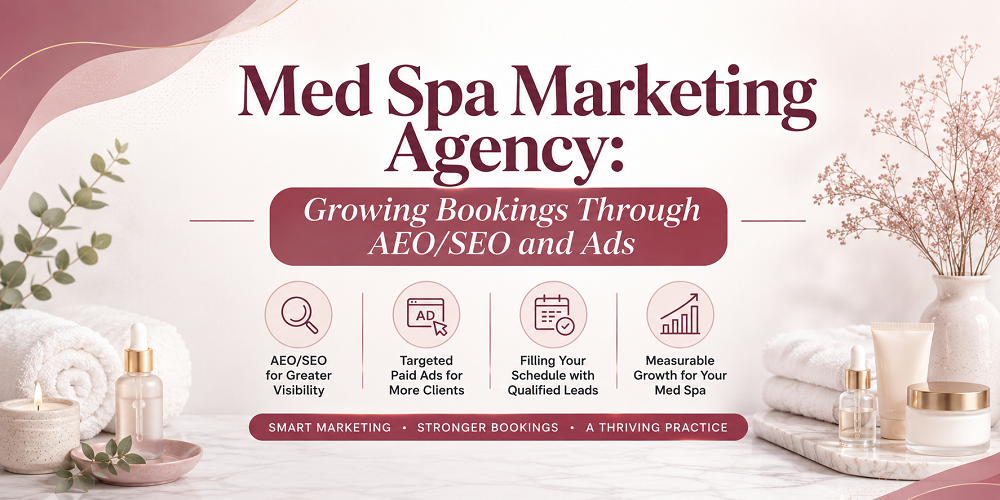
This guide covers what to actually look for in a med spa marketing agency, including the questions and red flags most buyer's guides skip: the regulatory reality behind who is legally allowed to oversee these treatments, and why that matters for what an agency can honestly claim on your behalf.
The med spa industry has grown quickly. A patient searching for Botox, laser hair removal, or a facial treatment finds dozens of options within a few miles, ranging from physician-led practices to small nurse injector suites. Standing out takes more than an appealing website and an active Instagram account. It takes a deliberate strategy that pairs solid SEO/AEO fundamentals with well-managed paid advertising.
Why Med Spas Face a Different Marketing Problem
Med spas sit at an unusual intersection of healthcare and consumer services. A patient researching Botox or dermal fillers is making a decision that involves genuine medical trust, since these are injectable procedures performed under medical supervision, alongside the kind of comparison shopping typical of any premium consumer service: pricing, before-and-after results, provider reputation.
That dual nature means aesthetics marketing cannot lean purely on clinical credibility the way a traditional medical practice might, and it cannot lean purely on visual content the way a beauty brand might. The agencies that actually move bookings build both at once: real medical trust alongside the compelling content that gets an aesthetic patient to act.
What a Strong Med Spa Marketing Agency Actually Offers
Med spa-specific AEO/SEO. Search behavior in this space is rapidly evolving. Someone searching "Botox near me" is close to booking and maybe using Google search; someone searching "how long does Botox last" or comparing Botox to Dysport is earlier in their research and maybe using AI platforms like chatGPT. A capable agency builds keyword-rich content strategy across that full range, since capturing patients earlier in their decision process tends to produce lower-cost, higher-intent leads over time. This also means dedicated pages for each major treatment, covering how it works, expected results, recovery, and general pricing, rather than a single page listing every service as a bullet point.
Local SEO and Google Business Profile. Since patients search locally, a complete Google Business Profile with detailed treatment listings, consistent business information, and active review management is one of the highest-leverage things an agency can manage. Ask specifically how they approach local pack rankings for aesthetic terms, since competition for something like "Botox near me" is often more intense than for general medical searches in the same city.
Paid search and social advertising. Paid advertising moves faster, particularly for competitive, higher-value treatments. A capable agency runs Google Ads against high-intent searches alongside Instagram and Facebook advertising built around visual results, and tracks cost per booked consultation, not just clicks or impressions. Ask how campaigns are structured around your highest-margin services specifically, since a well-built paid strategy prioritizes bookings that actually move revenue, not just broad awareness.
Before-and-after content strategy. This remains one of the most persuasive tools in aesthetics marketing, used well across a website, social, and paid ads, always with documented patient consent and consistent photography standards, matching lighting and angles matters more than it might seem for credibility.
Reputation management. Aesthetic patients lean heavily on reviews before booking, especially for higher-cost elective treatments. A good agency offers a structured system for generating reviews and features detailed, treatment-specific testimonials prominently rather than leaving reviews to accumulate passively.
Retention marketing. Treatments like Botox and fillers require repeat visits. Automated email or text reminders for renewal, paired with promotions for complementary services, meaningfully increase lifetime patient value beyond the first booking.
Questions to Ask Before Hiring
Do you have verifiable experience with med spas specifically?
Ask for case studies or references from other med spa clients, ideally with a similar treatment mix and competitive landscape to yours. General healthcare marketing experience doesn't always transfer cleanly to aesthetics, given how much consumer-style decision-making is layered on top of the medical side.
How do you measure return on ad spend?
A trustworthy agency explains how they track cost per booked consultation, not just cost per click, since surface metrics don't reflect actual business impact.
How do you decide which treatments to promote?
A thoughtful agency prioritizes based on real profitability and booking capacity, not just whichever service is easiest to make look good visually.
What does your content review process look like, and who signs off on claims involving injectable safety?
This is the question most buyer's guides skip, and it's the one that matters most. An agency should be able to name who reviews content touching on safety, side effects, or treatment comparisons before it publishes. If the honest answer is "no one with clinical knowledge," that's worth knowing before you sign anything, and it connects directly to the oversight question covered below.
How do you handle multi-location med spa marketing?
If you operate more than one location, confirm the agency has real experience coordinating local SEO and paid campaigns across locations, which takes more sophistication than a single-location setup.
Red Flags to Watch For
Overpromising immediate results. Paid ads can generate leads quickly; genuine organic SEO growth still takes months. Be cautious of anyone promising fast, dramatic ranking gains.
Reliance on vanity metrics. If reporting centers on follower growth, traffic, or impressions without ever connecting to booked consultations, it's difficult to know whether the investment is actually working.
No clear compliance awareness. Med spas are HIPAA-covered entities handling real clinical intake, medical history, contraindications, medication interactions, the same as any other medical practice. An agency with no apparent understanding of accurate, non-misleading claims around safety and results, or no awareness of who is legally required to oversee your practice's treatments, is a real concern, not a minor one.
Cookie-cutter strategy. Med spas differ meaningfully in treatment mix, target patient, and local competition. An agency running the same template regardless is unlikely to deliver results tailored to your actual market.
The Regulatory Reality Most Guides Skip
This is worth understanding on its own, separate from anything a marketing agency does, because it shapes what that agency can honestly say on your behalf.
Per AmSpa's own published practice guidelines, a med spa, as a medical practice, should be overseen by a supervising physician acting as medical director, regardless of what a given state's law technically requires. In practice, oversight varies a great deal by state. According to a peer-reviewed study in Dermatologic Surgery, reported by the American Medical Association, 36 states currently have no regulatory oversight of medical spas at all, and 44 states lack patient-protection regulations specific to them.
Why this matters for marketing specifically: a practice's actual medical oversight is part of what makes its safety and results claims credible in the first place. An agency that understands this distinction, and asks about it, is a better filter for whether a med spa is operating on solid ground than one that only asks about your treatment menu. If you're evaluating your own practice's marketing, confirming and clearly communicating your medical director's active involvement is a genuine trust signal to patients, not just a legal box to check.
Building a Balanced AEO/SEO and Ads Strategy
The most effective med spa marketing rarely leans on organic SEO or paid advertising alone. Organic work, med spa SEO, ongoing content, builds sustainable, lower-cost visibility over time. Paid advertising delivers more immediate volume, useful for filling appointment gaps or promoting a new treatment or seasonal offer. A good agency is transparent about how the two work together, gradually shifting budget toward organic as that visibility grows rather than maintaining heavy, indefinite reliance on paid alone.
Evaluating Ongoing Agency Performance
Once you've chosen an agency, set clear benchmarks early, covering realistic timelines for both paid performance and organic ranking improvement. Schedule real performance reviews, not just a static monthly report, that allow genuine discussion of which treatments and campaigns are working and where the strategy needs to adjust. Pay attention to whether the agency actually refines targeting and content based on real booking data over time, or keeps running the same plan regardless of results.
A Practical Checklist
Request verifiable case studies from other med spa clients specifically
Confirm dedicated experience with med spa and Botox-specific SEO
Review real examples of conversion-focused med spa website design
Clarify how Google Business Profile and local SEO are managed for aesthetic treatments
Ask how paid campaigns are structured and measured against booked consultations
Confirm before-and-after content follows proper consent and consistency standards
Ask about their approach to reputation management and review generation
Inquire about retention marketing, including email and SMS reminders
Confirm safety and treatment-claim content is clinically reviewed before publishing
Confirm the agency understands medical director and oversight requirements relevant to what your practice can claim
Watch for red flags: vanity-metric reporting, unrealistic promises, no compliance awareness
Where to Start
Growing bookings for a med spa takes a partner who understands both sides of this business: the medical trust that makes injectable treatments credible, and the consumer decision-making that actually drives bookings. The agencies worth hiring can demonstrate real, treatment-specific results, understand the regulatory ground your practice stands on, and stay honest about what SEO and paid advertising can each realistically deliver on what timeline.
Want to see what a real med spa marketing evaluation actually looks like? Sinopia's free SEO audit covers the technical, local, and content fundamentals in this guide, scoped specifically to aesthetics and injectable marketing. No cost, no obligation. Request your free audit.
Our healthcare SEO and local SEO services are built around the medical-plus-consumer approach this guide describes, our paid media team manages the ad side with cost-per-booking as the actual metric that matters, and our reputation management service handles the review-generation work covered above. See our broader aesthetics positioning on our plastic surgery marketing page, or read our related guide to dermatology marketing for the medical-specialty side of aesthetic patient trust.
FAQs:
Q1. How much does med spa marketing typically cost?
Costs vary widely by scope and market competitiveness. Rather than quote a specific figure we can't verify for your situation, the more useful framing: paid advertising costs scale directly with ad spend and stop producing leads the moment the budget does, while SEO and content work represent a slower, compounding investment. Ask any agency for a clear breakdown of what's included before comparing quotes.
Q2. How long does it take to see results from med spa AEO/SEO?
Paid advertising can generate bookings within weeks. Organic SEO improvements typically take three to six months to show meaningful movement, with continued growth as authority builds. Be skeptical of anyone promising faster organic results.
Q3. Is paid advertising necessary, or is SEO/AEO alone enough?
Both generally work best together. SEO builds durable, lower-cost visibility over time; paid advertising provides more immediate volume, particularly useful when launching a new treatment or filling near-term appointment availability.
Q4. What makes Botox SEO different from general med spa AEO/SEO?
Given how much search volume concentrates specifically around Botox, dedicated Botox SEO targets comparison searches, safety questions, and location-specific content in addition to broader med spa optimization.
Q5. Should I choose an agency that only works with med spas?
Not necessarily exclusively, but genuine, verifiable experience in med spa or broader aesthetics marketing is significantly more valuable than working with a generalist agency unfamiliar with how aesthetic patients actually research and book treatments.