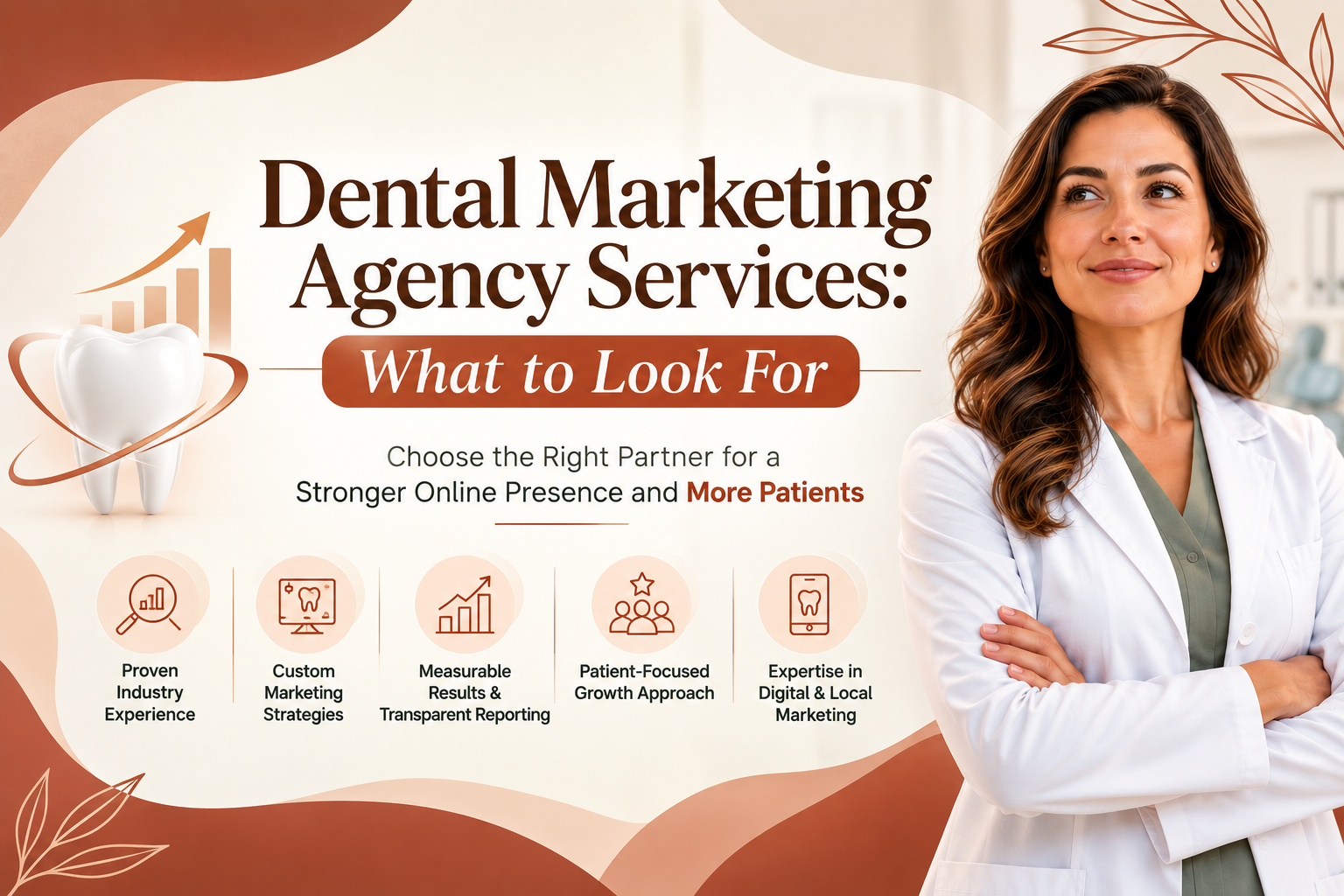
Choosing a dental marketing agency is one of the more consequential decisions a practice owner makes outside of clinical hiring. The right partner fills your schedule with new patients by building a web presence that drives new visitors to book appointments, and positions your practice as the clear choice in a competitive local market. The wrong one can burn through months of budget on vanity metrics and irrelevant web traffic that does not convert.
This guide covers what to actually look for in a dental marketing agency: the core services that drive real patient acquisition, the advertising rules most buyer's guides never mention, and the questions worth asking before you sign anything.
Why Dental Marketing Needs Specialized Expertise
Dentistry sits in an unusual spot within healthcare marketing. It carries the trust and compliance considerations of medical marketing, alongside the highly local, often elective nature of many dental services, everything from routine cleanings to cosmetic work like veneers or Invisalign. A generalist agency without dental-specific experience tends to miss the details that actually move results here: how differently a patient searches for an emergency toothache versus a cosmetic consultation, or how insurance-related content needs to be handled with genuine clarity and substantiation, not just reassuring language.
An agency with real dental SEO experience builds strategy around these distinctions rather than applying the same playbook it uses for unrelated industries.
Core Services a Dental Marketing Agency Should Offer
Dental AEO/SEO and local search. Most new patients start their search on Google, so this remains the foundation of dental patient acquisition. A strong agency offers keyword research built around actual dental search behavior, on-page optimization for service and location pages, technical SEO audits, and consistent citation building across dental-specific directories. Ask any prospective agency to explain their specific approach to local pack rankings, since that's often where dental practices see the clearest return. A vague answer about "SEO best practices" with no dental specificity is a real warning sign.
Google Business Profile management. Given how heavily local search drives dental patient acquisition, ongoing profile management matters: regular photo updates, accurate service listings, review monitoring, and consistent posting. If you operate multiple locations, ask specifically how the agency structures profile management across them.
Paid advertising. Google Ads and social advertising can accelerate acquisition for competitive service lines like Invisalign or implants. A capable agency is transparent about campaign structure and tracks cost per acquisition clearly enough that you can actually see return on ad spend, not just clicks.
Content marketing and patient education for AEO/GEO presence. Ongoing content, blog articles, educational video, supports AEO/SEO and patient trust. Ask whether content is written or reviewed by anyone with real dental knowledge. Generic, unreviewed content risks inaccuracies that undermine trust and, as covered below, can create real ethical and legal exposure specific to dentistry.
Reputation management. Patients rely heavily on reviews when choosing a dentist. A strong agency offers a structured system for generating consistent reviews and guidance for responding to both positive and negative feedback professionally.
Analytics and reporting. The most important service, arguably: clear reporting that connects marketing activity to actual outcomes, new patient calls, appointment requests, case acceptance, rather than vanity metrics like traffic or followers reported without context.
Compliance and Advertising Rules Most Guides Skip
This is the part almost no dental marketing guide covers, and it directly affects what an agency can honestly build or claim on your behalf.
The American Dental Association's ethics guidance addresses websites and search engine optimization specifically: dentists have an ethical obligation to ensure their web content, including content optimized for search, is truthful and not misleading in any material respect. This isn't a generic marketing-ethics platitude, it's a specific, named obligation tied directly to the service a dental marketing agency provides.
Beyond that, the ADA's marketing and advertising resources note that many states restrict dentists from claiming a procedure is curative or preventative, regulate how testimonials can be used in dental advertising, and in some cases prohibit guarantees in connection with dental services outright. These rules vary by state, so what's fine in one market may not be in another, an agency working across multiple locations needs to actually know this, not assume one national approach covers every state.
Two more specifics worth knowing before you sign anything:
Testimonials and reviews fall under FTC oversight, the same Endorsement Guides, 16 CFR Part 255, that govern healthcare testimonials generally. Any material connection between the practice and a reviewer (a discount, free treatment) needs disclosure, and before-and-after photos can't be edited or presented in a misleading way.
A general dentist can't advertise as a "specialist" unless the area is recognized as an actual dental specialty by the National Commission on Recognition of Dental Specialties, or by the relevant state. This is an easy detail for an inexperienced agency to get wrong, and it's a real compliance issue, not a stylistic one.
An agency that can speak to these specifics, unprompted, is demonstrating real dental industry knowledge. One that only offers a generic "we take compliance seriously" answer likely hasn't worked in this space closely enough to know what actually applies.
Questions to Ask Before Hiring
Do you have verifiable dental industry experience?
Ask for specific case studies or references from other dental practices, ideally similar in size or service mix to yours. An agency that can't provide concrete dental-specific examples should raise real questions about their actual specialty depth.
How do you measure and report success?
A trustworthy agency explains how they connect marketing activity to actual new patient numbers or appointment requests, not just rankings or traffic in isolation.
What does your onboarding and strategy process look like?
A thoughtful agency starts with a genuine audit of your current presence, competitive landscape, and specific goals rather than proposing the same templated package it sells everyone.
Who will actually be working on my account?
Many agencies sell prospective clients on a call with a senior strategist, then hand execution to a much less experienced team. Ask directly who manages the account day to day.
What is your understanding of ADA and FTC advertising requirements for dental marketing specifically?
This replaces a generic "how do you handle compliance" question with something the agency actually has to answer specifically, per the section above. A confident, specific answer here tells you more than almost anything else on this list.
What is included in your pricing, and what costs extra?
Clarify upfront exactly what's covered in a monthly retainer versus what incurs additional cost, ad spend, premium content production, website redesign work beyond routine maintenance.
Red Flags to Watch For
Guaranteed rankings or unrealistic promises. No legitimate agency can guarantee a specific ranking position, since search algorithms are controlled by Google, not by any agency. Treat explicit ranking guarantees with real skepticism.
Vague or generic strategy explanations. If an agency can't explain its specific approach to dental patient acquisition beyond generic marketing language, that often signals a lack of real specialty depth, regardless of how polished the sales pitch is.
Lack of transparent reporting. Agencies reluctant to provide clear, regular reporting, or that only share vanity metrics disconnected from actual patient acquisition, make it hard to know if the partnership is working.
Long-term contracts with no performance benchmarks. Some initial commitment is reasonable given how long SEO takes to show results, but be cautious of long lock-ins with no defined benchmarks or option to reassess.
One-size-fits-all packages. Dental practices vary significantly in size, specialty focus, and local competition. An agency offering only rigid, identical packages regardless of your specifics likely isn't tailoring strategy to your actual situation.
What to Expect: Cost and Timeline
Pricing for dental marketing agencies varies widely based on scope, market competitiveness, and how much of the service list above you're actually contracting for, so a single number rarely means much without that context. A more useful way to think about it:
Google Business Profile and local listing work shows up fastest, often within weeks, since it's primarily accuracy and completeness rather than content built from scratch.
Paid advertising can generate patient inquiries within weeks of launch, but volume stops the moment the budget does.
SEO and content work typically take three to six months to show meaningful ranking movement, longer in competitive metro markets or for high-value service lines like implants. This is the slower, compounding investment, not the fast lever.
Ask any agency you're evaluating for a clear breakdown of what's included at each tier, and treat a promise of fast organic results as a reason for caution rather than confidence.
A Brief Note on AI Visibility
The same credentialed, accurate, ADA-compliant content that builds patient trust is also what AI systems like ChatGPT and Google's AI Overviews look for when selecting a source to cite. There's no dental-specific trick to chase separately here. If you want the fuller picture of how AI search visibility actually works, see our guides to answer engine optimization and generative engine optimization.
Evaluating Ongoing Agency Performance
Once you've chosen an agency, set clear, mutually agreed benchmarks early: expected timelines for local pack improvement, traffic growth, or new patient inquiry volume. Expect regular, substantive communication throughout, not a single report delivered quarterly with no real context. Pay attention to whether the agency actually adjusts strategy based on what's working for your specific practice, or runs the same plan indefinitely regardless of results.
A Practical Checklist
Request verifiable case studies or references from other dental practice clients
Confirm the agency offers real dental SEO, not generic SEO services
Review their portfolio of actual dentist website design projects
Ask specifically how Google Business Profile management is handled
Clarify how paid campaigns are structured and tracked for dental practices
Confirm content is written or reviewed with genuine dental knowledge
Ask about their approach to reputation management and review generation
Confirm the agency understands ADA and FTC advertising requirements specific to dental marketing
Request a clear explanation of how success is measured and reported
Identify who will actually manage your account day to day
Watch for red flags: guaranteed rankings, vague strategy, rigid one-size-fits-all packages
Where to Start
Choosing the right dental marketing agency comes down to verifying genuine dental expertise, honest reporting, and services built around how dental patients actually search, compare, and decide, not a generic healthcare marketing playbook applied without adjustment. An agency that can speak specifically to ADA and FTC advertising requirements, show real dental case studies, and explain clearly how it measures success is a fundamentally safer bet than one relying on a polished pitch alone.
Want a clear picture of what a dental marketing agency evaluation should actually cover? Sinopia's free SEO audit reviews the technical, local, and content fundamentals in this guide, scoped to dental practices specifically. No cost, no obligation. Request your free audit.
Our healthcare SEO and local SEO services are built around the dental-specific approach described here, our paid media team tracks cost per acquisition as the metric that actually matters, and our reputation management service handles the review side covered above. See real client results on our case studies page, or explore our broader positioning on our dental marketing page.
FAQs:
Q1. How much does a dental marketing agency typically cost?
Costs vary widely based on scope and market competitiveness. Rather than a single figure, ask any agency for a clear breakdown of what's included in a retainer versus billed separately (ad spend, content production, website work), so you're comparing like for like across agencies.
Q2. How long does it take to see results from dental marketing services?
Paid advertising can generate inquiries within weeks. Organic SEO improvements typically take three to six months to show meaningful movement, with continued growth over time.
Q3. Should I choose an agency that specializes only in dental marketing?
Not necessarily exclusively, but genuine dental industry experience, backed by real case studies and dental-specific strategy knowledge, is significantly more valuable than working with a generalist agency unfamiliar with dental patient behavior.
Q4. Is it normal for agencies to require a long-term contract?
Some initial commitment is common given how long SEO takes to show results, but you should still expect clearly defined performance benchmarks and reasonable flexibility, not an indefinite lock-in with no accountability.
Q5. Are there rules around what a dental practice can claim in its marketing?
Yes. Beyond general truth-in-advertising principles, the ADA's own ethics guidance addresses website and SEO content specifically, many states restrict testimonials, guarantees, or claims that a procedure is curative or preventative, and FTC rules govern how reviews and before-and-after photos can be used. A marketing agency should understand these rules well enough to flag them proactively, not leave you to find out after the fact.
Q6. Can I switch agencies if results aren't meeting expectations?
Yes, though it's worth allowing a reasonable timeframe, generally at least six months, before concluding an SEO-focused strategy is genuinely underperforming, since organic results take time to materialize even with strong execution.