
 Healthcare SEO
 PPC & Google Ads
 Website Design
 Content Marketing
 Reputation Management
How Do You Build a 12-Month Content Marketing Plan for Doctors?


Why a Long-Term Plan, Not Just a Content Idea List
Healthcare content performs best when it focuses on useful, trustworthy, patient-first information rather than content created solely to rank. Search engines increasingly emphasize expertise, clear authorship, and helpful original content—especially for medical topics.
Step One: Establish Content Pillars
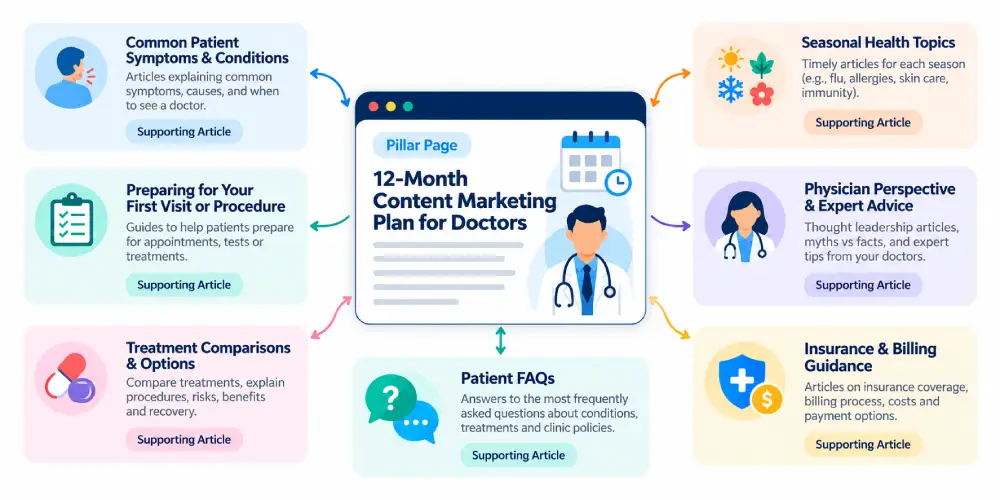
These pillars become the foundation for topic clusters: a comprehensive pillar page on a broad subject links out to several supporting articles on related subtopics. This structure builds real topical authority far more effectively than scattered, unrelated posts.
Step Two: Balance Content Types Across the Year
- Educational explainers answering direct patient questions
- Seasonal, timely content addressing recurring needs (flu season, allergy season)
- Condition deep dives, comprehensive pillar-style coverage of specific diagnoses
- Practical guidance posts covering logistics, what to expect at a first visit, how to prepare for a procedure
- Physician perspective posts, clearly attributed to a specific provider, sharing genuine clinical insight
How to build content range in a 12-Month calendar?
Month 1: A comprehensive pillar page on your practice’s primary specialty area, the anchor for future clusters.
Month 2: A commonly searched symptom or early warning sign, in clear language with real clinical depth.
Month 3: A practical, logistics-focused post, what to expect at a first visit, how to prepare for a procedure.
Month 4 (spring): Seasonal content, allergy management, outdoor activity safety, depending on specialty.
Month 5: A physician-authored perspective piece on a nuanced clinical topic.
Month 6: A second pillar page covering another core specialty area.
Month 7 (summer): Seasonal concerns, heat illness, travel health, pediatric summer safety.
Month 8: Revisit and update the Month 1 evergreen content, reflecting current freshness both for SEO and for AI-search performance.
Month 9 (fall): Flu shot reminders, back-to-school checklists, seasonal allergy transitions.
Month 10: A comparison-style article, useful for patients actively weighing treatment decisions.
Month 11: Another practical post, insurance navigation, a specific billing process relevant to your specialty.
Month 12: A comprehensive FAQ roundup of the year’s most common patient questions, genuine strong ground for featured snippets and AI citation.
Can the Framework be Adapted by Sepcialty?
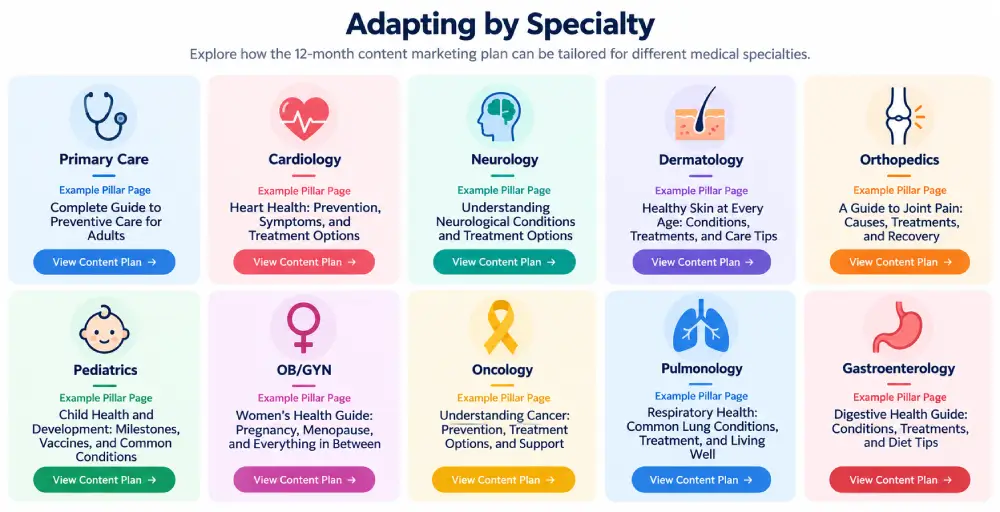
- Dental practices: Pillars might center on preventive care, cosmetic dentistry, and pediatric dentistry. A Month 4 seasonal post could cover back-to-school dental checkups; Month 10’s comparison piece might weigh clear aligners against traditional braces.
- Dermatology practices: Pillars naturally split into medical and cosmetic dermatology. Month 7’s seasonal content fits sun protection and summer skin concerns particularly well; Month 5’s physician-perspective post could address a commonly misunderstood condition, given how much unqualified skincare content already circulates online.
- Plastic surgery practices: Pillars around specific procedure categories work well, with Month 3’s practical post covering pre- and post-operative expectations, and Month 10’s comparison content addressing surgical versus non-surgical options for a given concern.
- Primary care practices: Broader pillars, preventive screenings, chronic disease management, wellness, fit naturally with Month 9’s flu-season content and Month 1’s foundational pillar page anchoring the practice’s full scope of care.
- Mental health practices: Pillars might address common conditions treated, therapy modalities offered, and when to seek care. Month 2’s early-warning-sign content is especially relevant here, helping patients recognize when a symptom pattern warrants professional support.
- Chiropractic practices: Pillars around specific pain conditions and treatment philosophy work well, with Month 10’s comparison content (chiropractic care versus physical therapy for a given complaint) tending to perform strongly.
- Orthopedic practices: Pillars by joint or injury type, with Month 3’s practical content covering surgical recovery expectations and Month 6’s second pillar page building out a distinct treatment area.
- Urgent care practices: Content skews more practical and immediate given the nature of the visits, Month 3 and Month 11’s logistics-focused posts (when to choose urgent care over the ER, what to bring) tend to be especially high-value here.
- Ophthalmology practices: Pillars around common conditions and elective procedures, with Month 4’s seasonal content well-suited to allergy-related eye symptoms.
- Multi-specialty clinics: Rather than one set of pillars, build a rotating structure where each specialty within the clinic gets dedicated months, preventing any one department’s content from crowding out the others.
Ensuring Every Post Actually Supports E-E-A-T
Key takeaways
- Build a 12-month strategy, not a collection of random topics.
- Focus on the doctor's specialty, treatments, and patient questions.
- Create topic clusters to establish topical authority.
- Include doctor expertise, credentials, authorship, and medical review.
- Optimize content for local search and answer engines.
- Repurpose blogs into videos, Reels, FAQs, and social content.
- Track appointments and leads, not just website traffic.
- Review and refresh existing content regularly.
- Prioritize quality, accuracy, and patient value over publishing volume.
Can I Repurpose Content for Maximum Value?
A well-built post shouldn’t exist in isolation. Each article in your 12-month plan can become a short social post highlighting the key takeaway, a brief video in which the physician discusses the topic directly, or a segment in a patient newsletter. This maximizes the return on the time invested in each piece while reinforcing consistent messaging across every patient touchpoint.
Assigning Realistic Responsibilities
Tracking Performance Throughout the Year
Common Mistakes That Undermine a Blog Plan
- Losing consistency after the first few months due to unclear ownership or an unsustainable publishing pace
- Focusing exclusively on broad, generic topics without ever building the specific, long-tail content that often converts better
- Publishing without physician review, relying entirely on generic AI-generated drafts that lack real clinical nuance
- Letting older content go stale indefinitely, allowing outdated medical guidance to remain published
A Practical Checklist for Your 12-Month Blog Plan
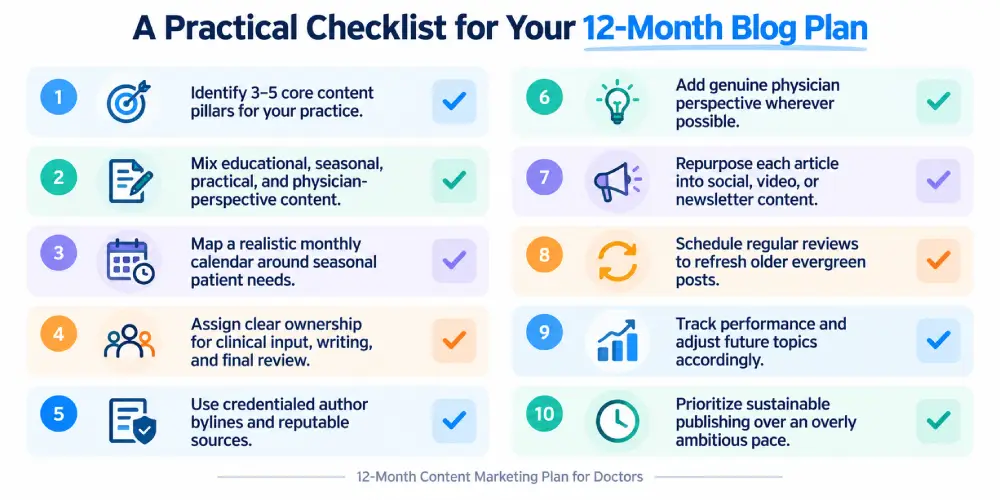
- Identify three to five core content pillars reflecting your practice’s specialties
- Build a balanced mix of educational, seasonal, practical, and physician-perspective content
- Map a realistic monthly topic calendar aligned with seasonal patient needs
- Assign clear ownership for clinical input, writing, and final review
- Ensure every post carries a credentialed author byline and reputable sourcing
- Incorporate genuine physician perspective wherever possible
- Repurpose each article into social, video, or newsletter content
- Schedule periodic reviews to update older evergreen posts
- Track performance data and adjust future topics accordingly
- Prioritize sustainability over an overly ambitious publishing pace
Where to Start
If you want the fuller picture of what makes healthcare content marketing work beyond the calendar structure itself, see our complete guide to content marketing for healthcare.
Want help building and executing your practice’s actual 12-month plan? Our content marketing team builds specialty-specific content calendars from this exact framework, tailored to your practice’s real pillars and patient volume. Get a free content strategy consultation.