
 Healthcare SEO
  PPC & Google Ads
  Website Design
  Content Marketing
 Reputation Management
Healthcare Marketing
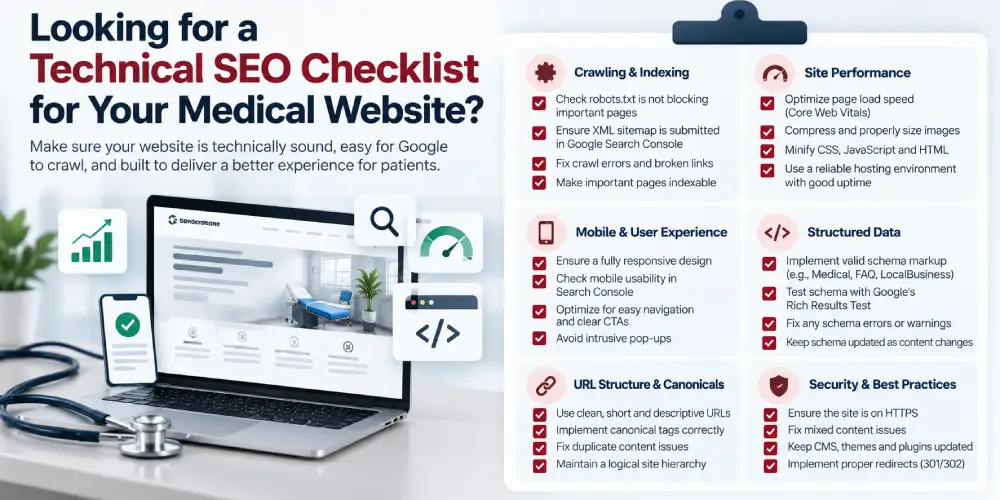
Looking for a Technical SEO Checklist for Your Medical Website?
Technical SEO ensures your medical website can be efficiently crawled, indexed, and understood by search engines while providing patients with a fast, secure, and mobile-friendly experience. Even strong healthcare content can struggle to rank when technical problems prevent search engines or users from accessing it properly.

Prem Kasera
Digital Marketing Strategist & Performance Marketer
Published Sep 5, 2026
•
12 min read
The short answer
A technical SEO checklist for a medical website should cover crawlability, indexation, Core Web Vitals, mobile usability, HTTPS security, structured data, XML sitemaps, robots.txt, canonical tags, redirects, broken links, and site architecture. Fixing these fundamentals creates a stronger foundation for healthcare SEO and patient experience.
A technical SEO audit checks whether search engines and AI systems can crawl, render, load, and trust your site, before any of your content or keywords get a chance to matter. Most published checklists are written for generic businesses. A medical practice has four technical layers a generic checklist never touches: HIPAA-safe tracking, accessibility compliance, AI-search readiness, and the canonicalization discipline that multi-location practices live or die by.
This checklist covers the standard fundamentals every site needs, verified against Google’s own documentation, and then the four healthcare-specific layers that separate a medical audit from a generic one. Where a point rests on a specific rule, it is sourced to the primary authority (Google, HHS, or the W3C), not to secondhand summaries.
Why a Medical Site Needs Its Own Technical Checklist
Search “technical seo audit checklist” and you will find 47-point and 50-point lists from the biggest names in the industry. Every one of them is written for a generic website. Not one addresses the fact that a healthcare site’s analytics stack can create legal liability, that its accessibility gaps can invite litigation, or that its location-page structure is usually its single biggest technical problem. The fundamentals below still apply to you. They are just not enough on their own. This is the same specialist-versus-generalist gap we describe in our guide to choosing a healthcare SEO, AEO and GEO agency.
What are Crawlability and Indexing Fundamentals?
- Robots.txt: confirm you are not accidentally blocking Googlebot from pages you want indexed. Googlebot access is what keeps you in Google Search and, by extension, eligible for AI Overviews.
- XML sitemap: present, current, submitted in Search Console, and listing only canonical, indexable URLs (200 status, no redirects or noindex).
- Indexation check: use Search Console’s Pages report to confirm your service and condition pages are actually indexed, not sitting in “Crawled, currently not indexed” or “Discovered, currently not indexed.”
- HTTPS everywhere: the entire site on a valid certificate with no mixed-content warnings. Non-negotiable for any site handling patient interaction.
- JavaScript rendering: if your site is built on a JavaScript framework, confirm search engines see fully rendered content, not an empty shell. This is not hypothetical; a client-rendered site can return real content to a browser while serving crawlers a near-empty page. Use Search Console’s URL Inspection tool and view the rendered HTML to verify.
What to Know About Site Speed and Core Web Vitals?
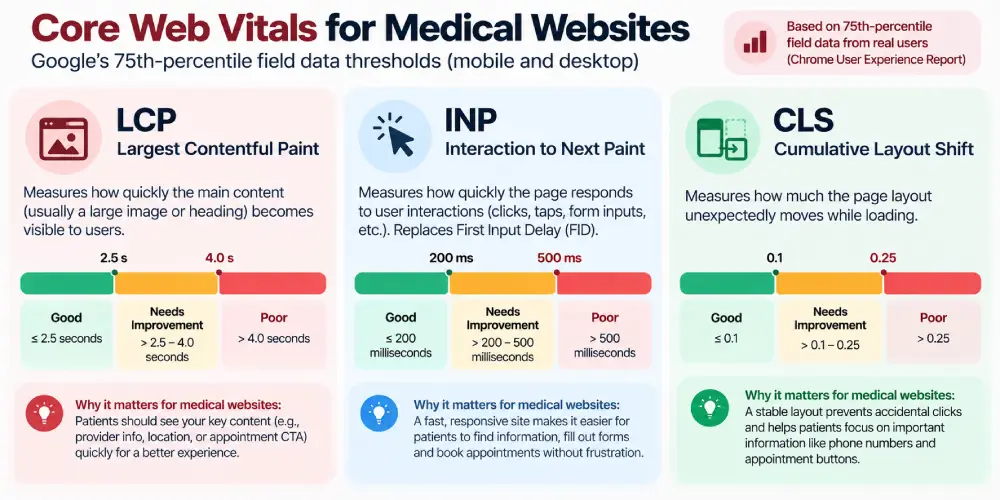
- Core Web Vitals, measured on real-user field data rather than a one-off lab score: Largest Contentful Paint (LCP) at 2.5 seconds or under, Interaction to Next Paint (INP) at 200 milliseconds or under, and Cumulative Layout Shift (CLS) at 0.1 or under, each at the 75th percentile of real visits per Google’s guidance. INP replaced First Input Delay in 2024, so any checklist still listing FID is out of date.
- Mobile experience: your site is graded on its mobile version. Confirm comfortable tap targets, readable text without zoom, and no horizontal scroll, especially on the appointment-booking flow, where a shifting layout costs you a patient, not just a metric.
- Image optimization: compressed, correctly sized, served in modern formats where supported, and lazy-loaded below the fold. Provider photos and facility images are usually the heaviest elements on a medical page and the most common cause of a failing LCP.
How Should You Handle Site Structure, Schema, and Duplication?
- Canonical tags: every page declares a self-referencing canonical, and paginated or parameter URLs point to the right target. For multi-location practices this is the highest-leverage item on the list. Check Search Console’s “Duplicate, Google chose a different canonical than user” report, because competing location-page templates are the most common way a practice quietly splits its own ranking signals. We cover the fix in our guide to multi-location SEO.
- Structured data: valid, error-free, and matched to visible content. Use Organization or MedicalOrganization sitewide, Service per service line, and FAQPage where you have genuine questions and answers. One accuracy note that dates many checklists: FAQ rich results were removed from Google Search in May 2026, and FAQ support leaves the Rich Results Test in June 2026, so validate your JSON-LD against schema.org rather than expecting FAQ-specific feedback from Google’s tool. The markup still helps machines parse the page; it simply no longer renders a dropdown. Full detail in our FAQPage schema strategy guide.
- URL and heading structure: clean, readable URLs, one H1 per page, and a logical heading hierarchy that describes the content rather than styling it.
- Internal linking: no orphaned pages, service and condition pages linked with descriptive anchor text, and broken internal links and redirect chains cleaned up.
How to Set Up HIPAA-Compliant Tracking and Analytics for Healthcare Sites?
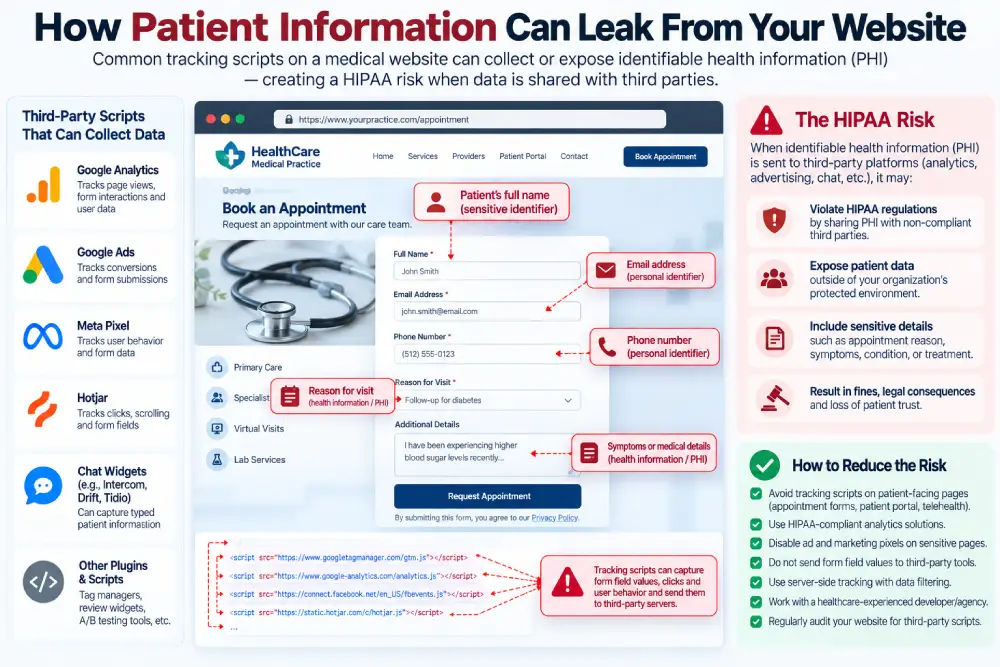
This is the layer no generic checklist includes, and the one with real legal consequences. Treat it as part of the technical audit, not a separate compliance errand handled by someone else later.
- Inventory every tracking script: Google Analytics, the Meta Pixel, ad-platform tags, chat widgets, heatmap tools, and any third-party form handler. Know exactly what fires on every page.
- Audit the pages that carry risk first: appointment forms, patient-portal entry points, and condition-specific landing pages. Per HHS/OCR guidance on online tracking technologies, transmitting identifiable health information to a third party through these tools can be a reportable disclosure, even when no one intended it.There are nuances where authenticated pages have HHS guidance is fully in effect but not so for unauthenticated pages. This is ongoing legal risk and should be monitored.
- Confirm that form handlers and any covered tools sit under a Business Associate Agreement, and that server-side event payloads are scrubbed of anything identifying. We walk through the full technical picture in our guide to what makes a website HIPAA compliant.
What are Technical Requirements for Accessibility in Healthcare Sites?
Accessibility overlaps heavily with technical SEO, since clean headings, alt text, and keyboard navigation serve both. For a medical practice it also carries legal weight, which is why it belongs in the audit rather than a design wish-list.
- Check against WCAG 2.1 AA Title III the standard courts and regulators reference: sufficient color contrast, descriptive alt text on informative images, full keyboard navigation, clearly labeled form fields, and a correct heading order.
- Prioritize the booking and intake flow. An appointment form a screen-reader user cannot complete is both an accessibility failure and a lost patient. More on this in our guide to medical website design.
How do You Get AI-Search Ready in Healthcare?
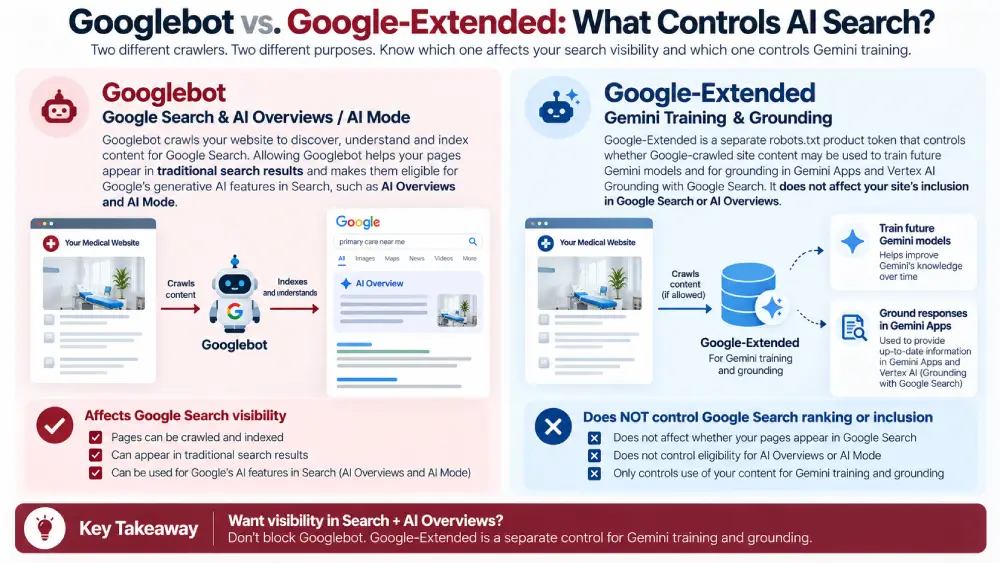
A large and growing share of Google searches now surface an AI Overview, and patients increasingly ask an AI assistant before they ever reach a website. The technical groundwork for being cited is verifiable, not mysterious.
- No special schema required. Per Google’s own AI-features documentation, there is no separate markup or technical track for AI Overviews or AI Mode. The same crawlability, speed, and structured-data soundness in this checklist is what makes a page extractable. Anyone selling a separate “AI schema” product is selling something Google has said does not exist.
- Make a deliberate robots.txt decision on Google-Extended. It is a control token for Gemini training and grounding, and per Google’s crawler documentation, it does not affect your Google Search ranking or your AI Overviews eligibility, both of which ride on Googlebot access. Allow it or disallow it on purpose, rather than leaving it to accident.
- Use the Search Console generative AI performance report (rolled out to all sites worldwide in 2026) to see impressions from AI Overviews and AI Mode, and confirm you have not toggled your content out of AI features unless that was a deliberate choice. The mechanics of getting cited accurately are covered in our guides to answer engine optimization and generative engine optimization.
Why technical SEO matters for medical websites
Healthcare websites often contain service pages, provider profiles, location pages, educational resources, and appointment pathways. Technical problems such as duplicate URLs, slow pages, broken links, incorrect canonical tags, or accidental noindex directives can prevent important pages from performing in search. A technically healthy site also makes it easier for patients to find information and take the next step.
How Often Should You Run your Technical SEO/AEO/GEO Audit?
A full technical audit belongs on the calendar quarterly, plus any time you launch new pages, migrate the site, or change your forms or tracking stack. The HIPAA-tracking check specifically should run every time marketing adds a new tag or tool, because that is exactly the moment unintended disclosures get introduced.
Where to Start
Run the six sections in order because fundamentals first. A fast, accessible, well-structured page is of no value if a crawler cannot index it in the first place. Then treat the three healthcare layers as non-optional, because they are precisely the ones a generic audit, and a generic agency, will miss.
Want the whole picture in one pass? Our SEO and AEO audit reviews your technical foundations, HIPAA-tracking exposure, accessibility, and AI-search readiness together, not as disconnected line items, including whether your current tracking stack carries any PHI-exposure risk. No cost, no obligation. Request your free audit.
Key takeaways
- Make sure important medical pages are crawlable and indexable.
- Submit and maintain an accurate XML sitemap.
- Review robots.txt and noindex directives.
- Improve Core Web Vitals and overall page speed.
- Keep the website mobile-friendly and responsive.
- Use HTTPS across the entire medical website.
- Fix broken links, redirect chains, and 404 errors.
- Implement canonical tags correctly to control duplicate URLs.
- Add appropriate structured data for organizations, physicians, services, FAQs, and other eligible content.
- Maintain a clear internal-linking and site architecture.
- Monitor indexing and technical issues through Google Search Console.
- Audit the website regularly rather than treating technical SEO as a one-time task.
Frequently Asked Questions
Q1. What is a technical SEO audit?
A technical SEO audit checks the non-content foundations of a site: whether search engines and AI systems can crawl it, render it, load it quickly, and trust its structure. It covers crawlability, indexing, site speed and Core Web Vitals, mobile usability, structured data, and canonicalization, before content and keywords come into play.
Q2. How is a technical SEO checklist different for a medical practice?
A medical practice adds four layers a generic checklist ignores: HIPAA-safe configuration of analytics and tracking, WCAG accessibility compliance, AI-search readiness, and the canonicalization discipline that multi-location practices need so they do not split their own ranking signals across competing location pages.
Q3. What Core Web Vitals should I hit in 2026?
LCP at 2.5 seconds or under, INP at 200 milliseconds or under, and CLS at 0.1 or under, each measured at the 75th percentile of real-user data. INP replaced First Input Delay in 2024, so a current audit measures INP, not FID.
Q4. Does FAQ schema still help after Google's 2026 change?
The FAQ rich result (the expandable dropdown) was removed from Google Search in May 2026, but FAQPage remains a valid schema type Google still uses to understand a page. Keep the markup for machine-readability and validate it against schema.org, since FAQ support is leaving Google’s Rich Results Test in June 2026.
Q5. Can my analytics setup really cause a HIPAA problem?
Yes. Standard tools like Google Analytics or the Meta Pixel placed on patient-portal or condition-specific pages can transmit identifiable health information to a third party, which HHS/OCR guidance treats as a potential disclosure. It is a technical configuration issue, which is exactly why it belongs in a technical audit rather than being left to a separate compliance review.
About the authors
Prem Kasera is a seasoned digital marketing strategist, performance marketer, and writer specializing in search engine optimization (SEO), answer engine optimization (AEO), and generative engine optimization (GEO). With over 20 years of experience driving growth across e-commerce, healthcare, and agency environments, Prem crafts insight-driven articles and blogs on Sinopia. His writing focuses on technical SEO, content cluster frameworks, paid media strategy, and navigating AI search paradigms to help brands build measurable visibility and authority.