
 Healthcare SEO
  PPC & Google Ads
  Website Design
  Content Marketing
 Reputation Management
 How Physician Website Design Builds Real Patient Credibility

Why Physician Website Design Is a Different Problem Than Practice Design
Practice-level website design focuses on broad elements: navigation, services, booking flow. Physician website design operates at a more personal level, because a patient isn’t just choosing a clinic; they’re choosing a specific person. If you’re looking for the practice-level foundation this builds on, from mobile design to HIPAA-compliant forms, see our guide to medical website design. This guide picks up where that one leaves off.
This distinction also matters for search visibility, not just conversion. A detailed, well-attributed physician profile reinforces the Expertise and Authoritativeness components of E-E-A-T, the quality framework Google’s human raters use to evaluate content, which we cover in more depth in our guide to answer engine optimization.
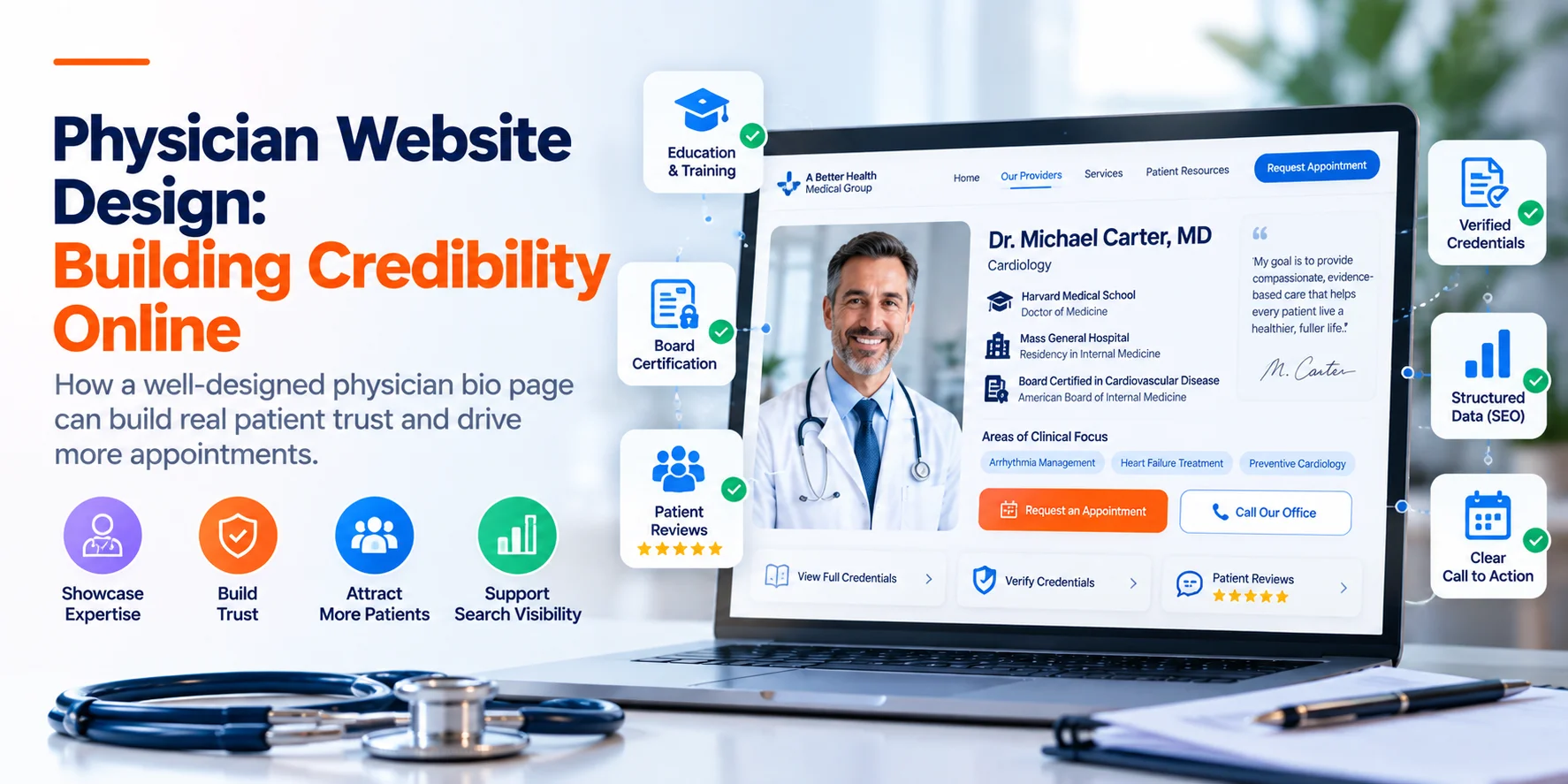
Patients are choosing a specific physician, not just a medical practice, so provider pages need to make expertise and credibility easy to understand and verify. Practices should keep physician information consistent across directories, publish physician-authored content, showcase relevant social proof, and make credentials independently verifiable through trusted sources such as NPPES, Certification Matters, and DocInfo.org.
What is The Anatomy of a High-Converting Doctor Bio Page
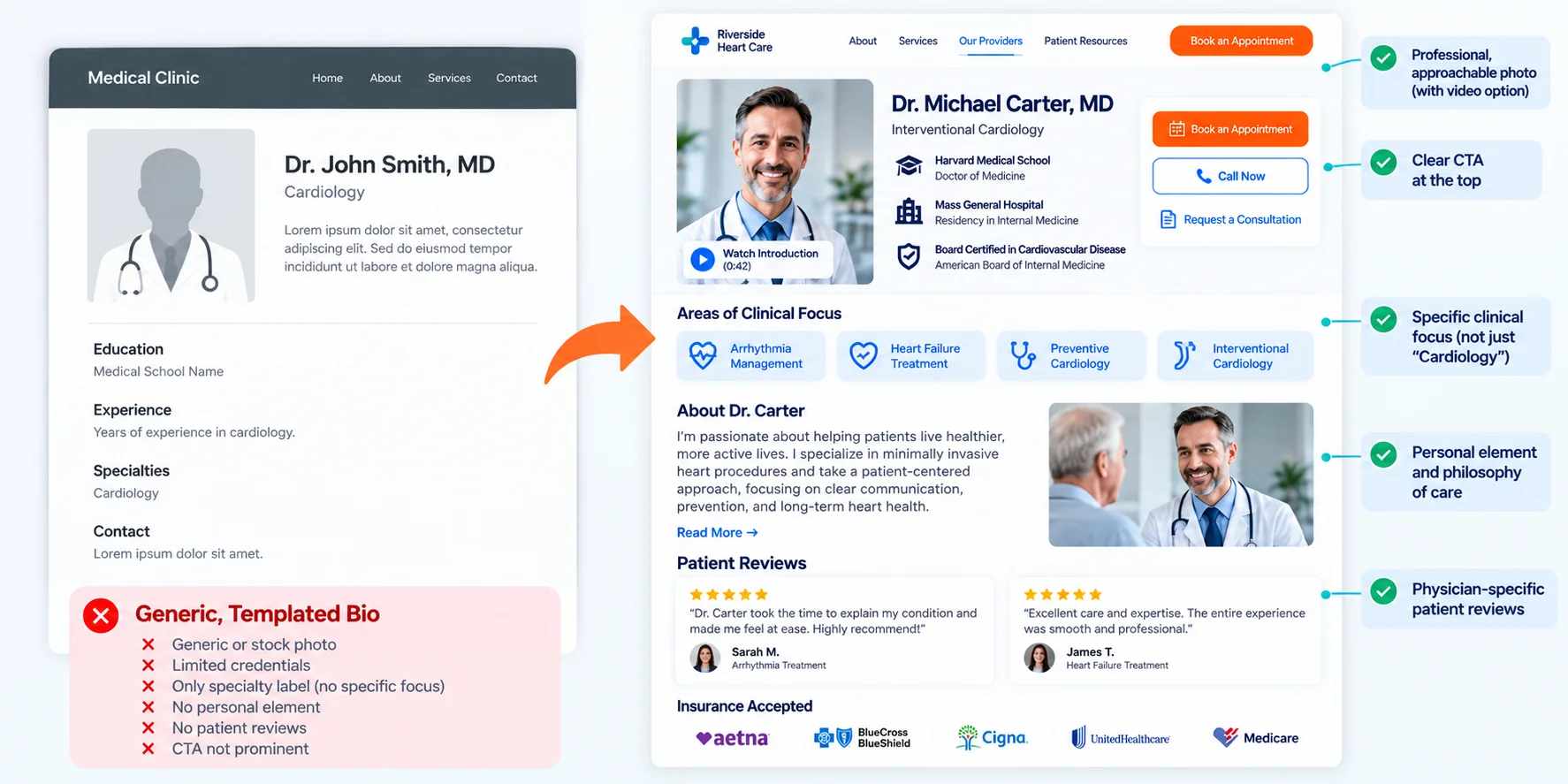
Are you using a professional yet approachable photo? The photo is often the first thing a patient notices, and it sets the emotional tone immediately. Generic stock photography or a dated headshot undermines credibility fast; patients can usually tell. A genuine, professionally taken photo that reads as warm and competent does real work here. A short video introduction alongside it, even 30 seconds, meaningfully increases patient comfort before an appointment is ever booked.
Do you have clear, specific credentials? Medical school, residency, fellowship if applicable, and board certifications, easy to scan, not buried in a paragraph. Clean formatting matters as much as the content itself; patients and search engines both benefit from clarity here.
List Specific areas of clinical focus, not just a specialty label. A cardiologist who lists arrhythmia management, heart failure treatment, and preventive cardiology gives a patient something to match their concern against. “Cardiology” alone doesn’t. This specificity does double duty: it helps patients self-select correctly, and it strengthens topical relevance for the specific conditions a physician’s page should actually rank for.
Is it genuinely personal? Credentials alone don’t build emotional trust. A brief, real section on philosophy of care, what drew this physician to the specialty, even an appropriately shared personal detail, turns a credential list into something a patient connects with. This is the Experience component of E-E-A-T in practice: a physician’s own voice describing their approach is a first-hand signal that generic, templated content can’t fake.
Showcase Physician-specific patient reviews. Practice-wide reviews are useful; reviews attributed to a specific physician carry more weight on that physician’s own page, especially ones mentioning a specific condition or bedside manner. Where possible, display a few directly on the bio page rather than sending patients to click through to a separate reviews page, reducing friction at the exact moment they’re deciding.
Is there a clear call to action placed high on the page? Every bio page needs an obvious next step, a booking button, a click-to-call number, a provider-specific contact form, positioned near the top, not just at the bottom. A patient who’s already convinced shouldn’t have to scroll through the whole page to act.
Ensure accurate, honestly framed structured data. Physician and Article schema give search engines and AI systems explicit, machine-readable information about a physician’s name, credentials, and specialty. Worth being precise here: this markup helps systems parse who you are; it does not by itself produce a Google rich result or guarantee an AI citation. We verified this directly against Google’s own documentation in our AEO guide. Use it because it makes your entity legible, not because it’s a shortcut to visibility.
How does the Verification Layer for Bio Pages work?
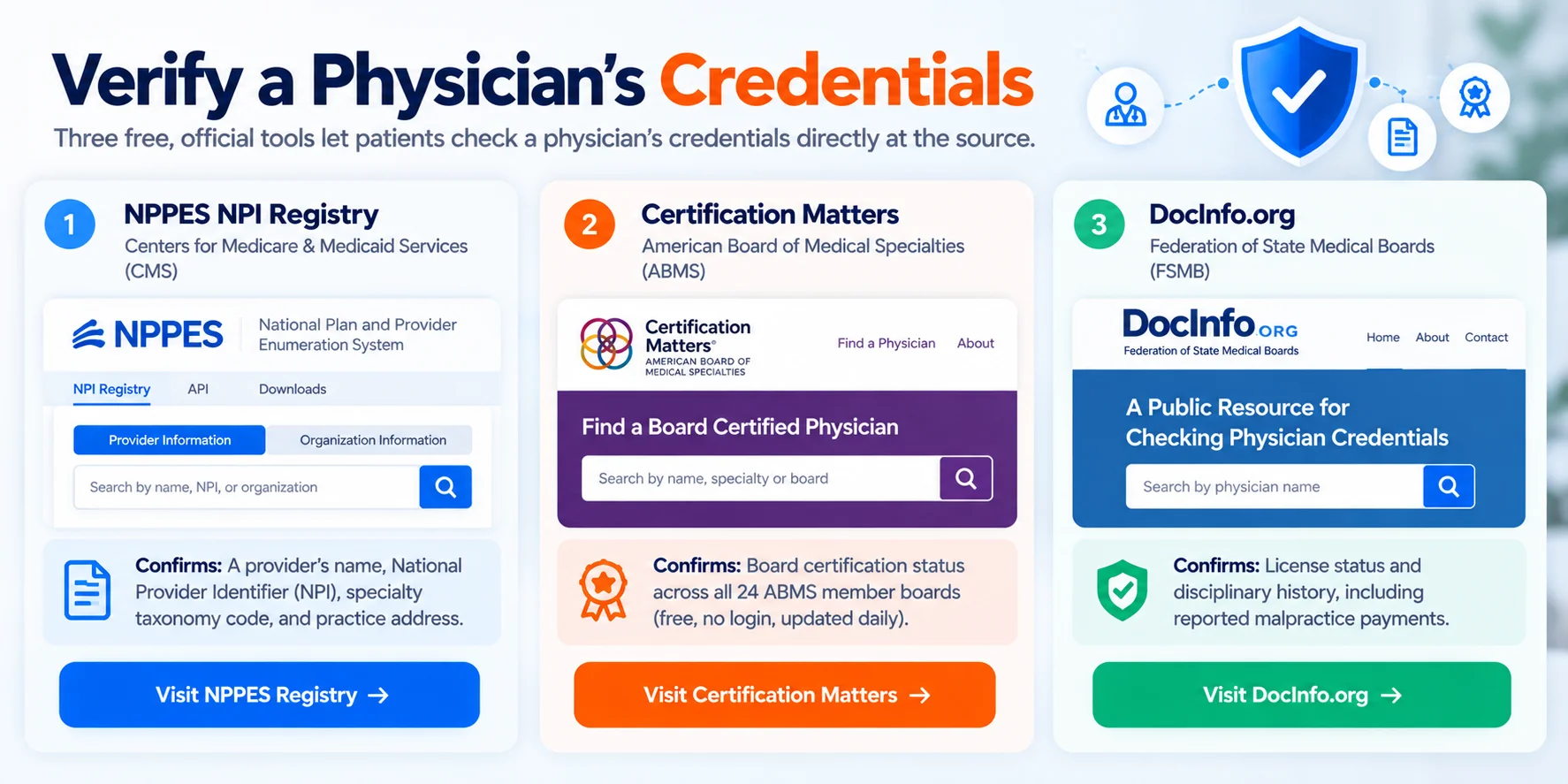
Everything above builds a bio page that reads as credible. This section is what makes it actually verifiable, and it’s the piece almost no physician website includes.
Three free, official tools let anyone check a physician’s credentials directly at the source, not take a marketing claim on faith:
The NPPES NPI Registry, maintained by the Centers for Medicare & Medicaid Services, confirms a provider’s name, National Provider Identifier, specialty taxonomy code, and practice address. It confirms identity and specialty classification, not licensure or board certification; those are separate questions.
Certification Matters, run directly by the American Board of Medical Specialties, verifies board certification status across all 24 ABMS member boards, free, no login, updated daily, and is built on the same ABMS certification data that the Joint Commission and the National Committee for Quality Assurance credentialing relies on.
DocInfo.org, run by the Federation of State Medical Boards, is the most comprehensive public source for license status and disciplinary history, including reported malpractice payments.
Building Credibility Beyond the Bio Page
Consistent information across every platform. Name, credentials, and practice affiliation need to match across the website, Healthgrades, Zocdoc, and any professional association listing. Inconsistency quietly undermines trust and can confuse search and AI systems trying to confirm identity.
Physician-authored content, published regularly. A static bio page establishes credibility once. Ongoing content actually written or reviewed by the physician- blog posts on common patient questions, brief explainer videos, commentary on new treatment options- reinforces the same Expertise and Authoritativeness signals continuously rather than as a single page.
Professional social proof. Linking to a physician’s listing on a medical association site, or to published research, adds real third-party corroboration. This matters more as AI systems increasingly attempt to cross-verify claimed expertise against outside sources, not just take a website’s word for it.
What are the Common Design Mistakes That Undermine Credibility?
- Avoid templated bios where only the name and specialty change between providers feel impersonal and fail to differentiate anyone.
- Remove outdated information, credentials, or focus areas that no longer match reality; it quietly erodes trust, especially if a patient notices the inconsistency elsewhere.
- Don’t bury bios several clicks deep in navigation. Provider pages belong directly in the main navigation or a clear provider directory, not hidden in a generic About submenu.
- Optimize for mobile display; cramped text and awkward photo cropping undo the credibility a strong bio would otherwise build, especially given how much provider research happens on a phone.
Key takeaways
- Use a professional, approachable physician photo.
- Clearly display education, residency, and board certifications.
- Highlight specific clinical areas rather than only the physician's specialty.
- Add a genuine section about the physician's approach to care.
- Include physician-specific patient reviews where available.
- Place a clear booking or contact CTA near the top of the page.
- Use accurate Physician and Article schema.
- Link to NPPES, Certification Matters, or DocInfo.org for independent verification.
- Keep physician information consistent across the website and directory listings.
A Practical Checklist for Physician Bio Pages
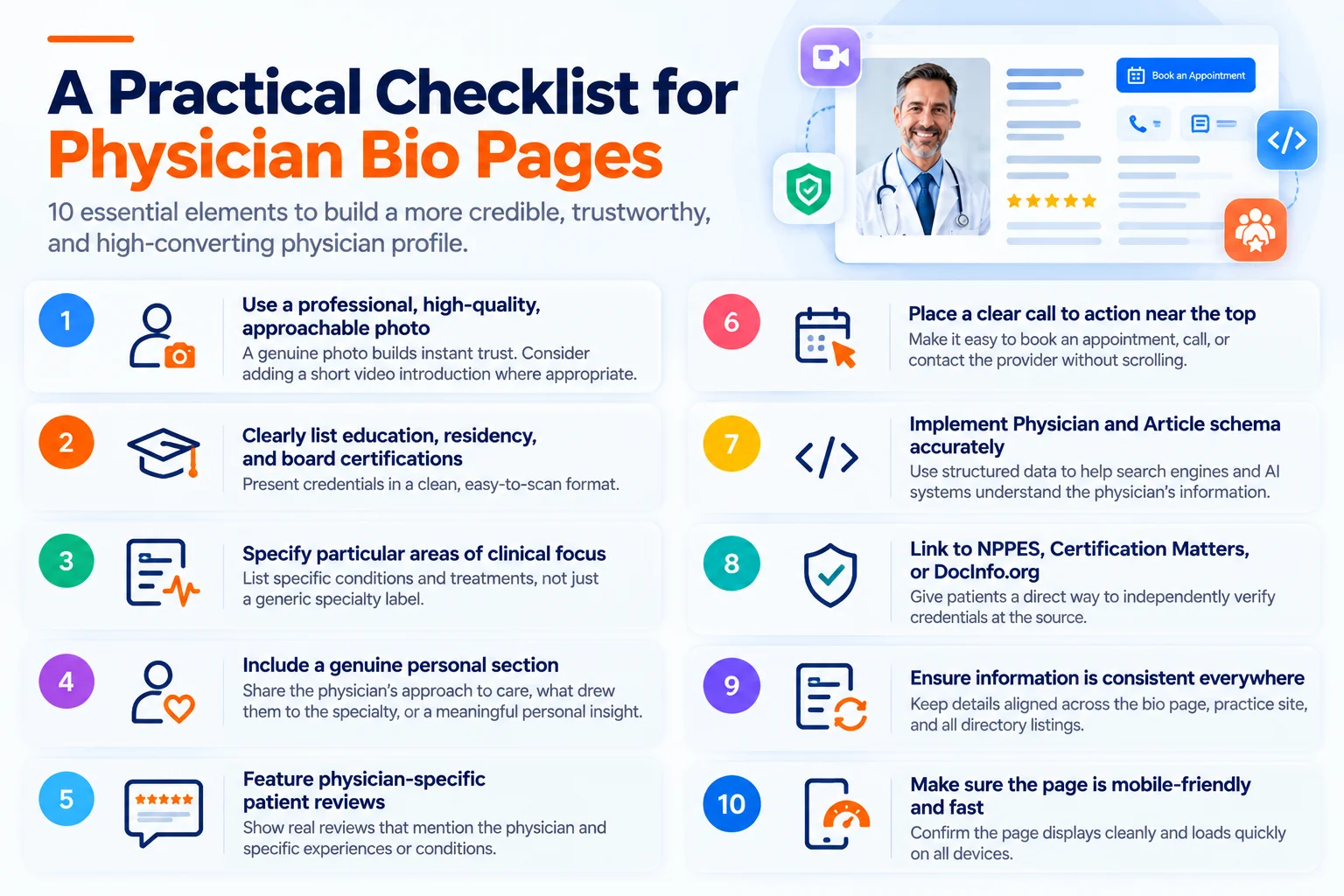
- Use a professional, high-quality, approachable photo; video introduction where appropriate
- Clearly list education, residency, and board certifications, formatted for easy scanning
- Specify particular areas of clinical focus rather than a generic specialty label
- Include a genuine personal section reflecting the physician’s approach to care
- Feature physician-specific patient reviews where available
- Place a clear call to action near the top of the page, not just the bottom
- Implement Physician and Article schema accurately, as a machine-readability aid, not a rich-result guarantee
- Link directly to NPPES, Certification Matters, or DocInfo.org for independent verification
- Ensure information is consistent across the bio page, the practice site, and every directory listing
- Confirm the page displays cleanly and loads quickly on mobile
Where to Start
Want us to run the Physician Credibility Checklist against your current bio pages? Our free SEO audit reviews provider pages against every element in this guide, design and verification both. No cost, no obligation. Request your free audit.
Our website design team builds provider bio pages around these principles from the start, and our reputation management and healthcare SEO services carry that credibility through to reviews and search visibility as well.
Frequently asked questions
Q1: How long should a physician bio page be?
No strict word count, but most effective bio pages run 300 to 600 words, enough to convey real credentials and personality without overwhelming a patient trying to decide quickly.