
 Healthcare SEO
 PPC & Google Ads
 Website Design
 Content Marketing
 Reputation Management
Social Media Marketing for Healthcare: Platforms, Compliance, and ROI


Why Healthcare Social Media Needs a Different Approach?
How to Choose the Right Platforms for Your Practice?
| Platform | Best Fit | What Works / Key Considerations |
|---|---|---|
| Specialties with a strong visual or lifestyle component: dermatology, dentistry, physical therapy, pediatrics | Behind-the-scenes content, patient education reels, and team introductions tend to generate real engagement, since the platform rewards authentic content over purely promotional posts | |
| Broad demographic reach and strong local community group presence; tends to perform well for practices serving an older patient population | Its advertising platform offers detailed local targeting, though healthcare advertisers may face real restrictions on how that targeting can be configured | |
| Physician personal branding, hospital systems, and B2B relationships like referral network building | Generally less relevant for direct patient acquisition for most individual practices | |
| TikTok | Practices willing to invest in short, educational video; a growing source of health information, particularly among younger patients | Requires the same careful compliance oversight as any platform, arguably more given its fast, informal content style |
| YouTube | Healthcare education specifically | Strong long-term value, with videos explaining a condition or procedure often keep generating views for years, functioning almost like an evergreen library alongside a practice's blog |
How to Get Started on Building a Compliant Foundation?
Understanding what actually counts as PHI on social media. Most practices assume compliance risk only applies to obvious situations, like posting a medical record. In reality, PHI can leak in far subtler ways: a patient commenting on their own treatment under a post, or a practice publicly confirming someone is a patient by responding to a comment that references their care. Staff need to understand that any public acknowledgment connecting an identifiable person to a health condition or treatment, even indirectly, can constitute a violation.
Obtaining proper consent for patient content. Featuring real patients, testimonials, before-and-after photos, event coverage, requires explicit, documented consent specifically for that use. A general treatment consent form doesn’t cover social media use; practices need a separate release addressing exactly how patient images or stories may be used across platforms.
Configuring genuinely HIPAA-safe social ads. This is where most guidance stops at “be careful with pixels” without saying what that actually means in practice. It’s worth being specific, because the rules have gotten more concrete.
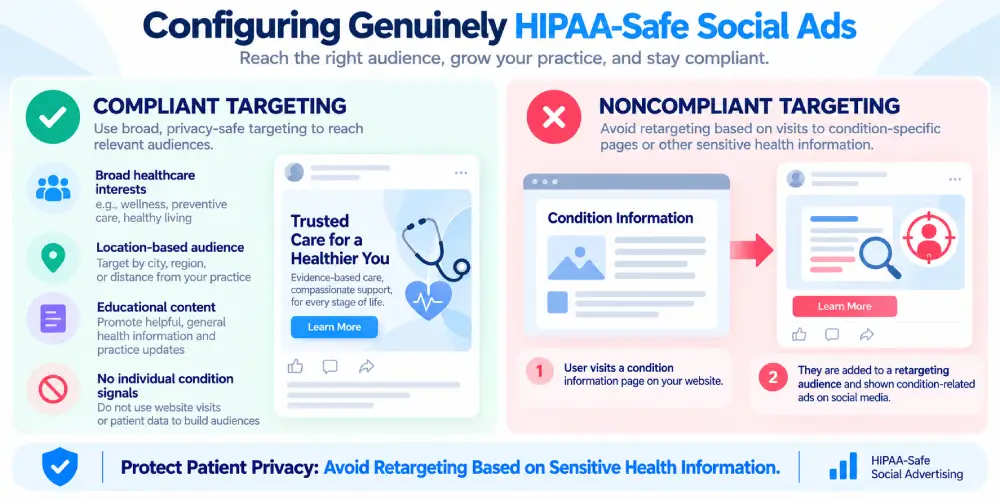
As of 2025, Meta expanded its Health and Wellness advertising restrictions to cover any advertiser whose offering is associated with medical conditions, specific health statuses, or a provider/patient relationship, which is essentially all healthcare advertisers, not just pharmaceutical companies. The core rule, per Meta’s own Transparency Center, is that ads cannot assert or imply knowledge of a viewer’s personal health condition, Meta’s “personal attributes” policy. A line like “struggling with anxiety? We see you” violates this directly, regardless of intent, since it implies the platform knows something personal about the viewer.
- Check your Data Source Category under Events Manager > Settings > Manage Data Source Categories. This isn’t a setting you configure, Meta assigns it automatically based on a crawl of your domain and your event-payload history, then surfaces a restriction level (Core Setup, restrictions on standard events, or full restrictions). If your practice looks miscategorized, file an appeal through that same Events Manager screen rather than looking for a setting to fix.
- Never build retargeting audiences from visitors to condition-specific pages, build from broader, upper-funnel signals instead
- Avoid optimizing campaigns toward “purchase” or “appointment booked” conversion events tied to health-specific landing pages, since that structurally implies a treatment relationship to the platform
- If using server-side conversion tracking (Meta’s Conversions API or similar), verify no PHI parameters appear in the event payload before it’s sent
Establishing a written social media policy. Every practice active on social media should document who’s authorized to post, how to handle comments referencing personal health information, and a clear escalation path for compliance concerns. A documented policy reduces actual risk and demonstrates accountability if a compliance review ever happens.
What Content Strategies Build Genuine Engagement?
- Patient education content, short, clear explainers addressing common questions, performs consistently well. A brief video on when a headache warrants medical attention, or a simple graphic on warning signs for a specific condition, provides real value that encourages shares while reinforcing clinical expertise.
- Behind-the-scenes and team content humanizes a practice, staff introductions, the physical office, small moments from daily practice life. This builds familiarity well before a first visit, lowering the anxiety that often comes with choosing a new provider.
- Physician perspective content, a physician discussing a health topic in their own words, tends to outperform generic, unattributed content, combining real expertise with the personal connection that builds trust. This reinforces the same Experience and Expertise signals covered in our broader AEO work.
- Seasonal and timely content, flu shot reminders, sun safety, allergy season, keeps a practice’s presence relevant and gives patients practical value tied to what they’re already thinking about.
- Community involvement content, coverage of local health fairs, school partnerships, wellness events, reinforces local presence and often generates organic engagement from people who recognize the event.
How to Measure ROI?
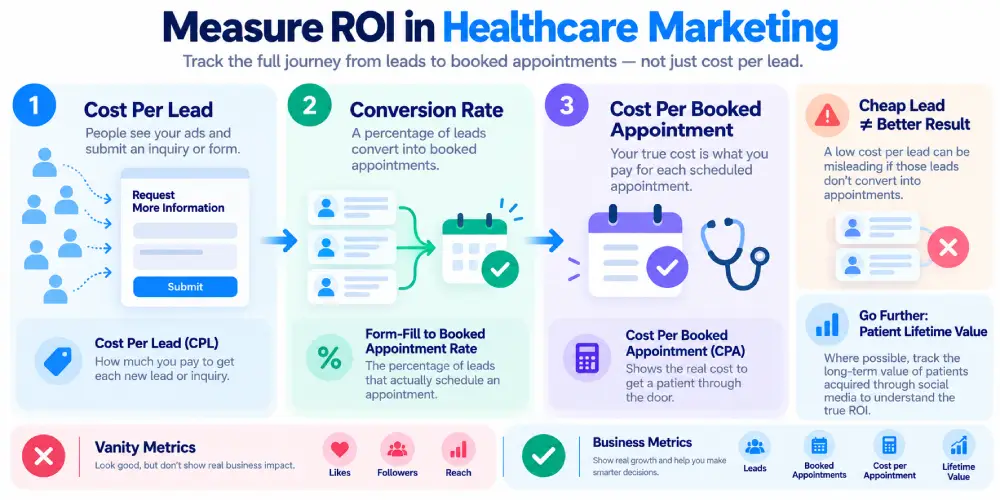
- Track cost per booked appointment, not just cost per lead, by platform and campaign. A cheap lead that never converts is worse than an expensive one that reliably books. Use dedicated tracking links, call tracking numbers, or platform-specific booking integrations to attribute appointments back to the actual channel, rather than assuming influence.
- Track the form-fill-to-booked-appointment conversion rate specifically for each channel. This is the metric most practices skip, and it’s often the one that changes the actual budget decision. A platform generating twice the leads at half the conversion rate isn’t automatically the better investment.
- Where the data allows, track patient lifetime value by acquisition channel. Some channels may bring in patients needing a single visit; others may bring in patients who need ongoing care. Cost per lead alone can’t distinguish between those outcomes, but lifetime value can.
- Evaluate engagement quality, not just volume. A smaller number of thoughtful comments and shares from genuinely local, relevant followers often reflects stronger real-world impact than a large but disengaged following, particularly for practices focused on local acquisition over broad brand awareness.
- Track whether engagement is trending upward over time, not just how any single post performed, since this reflects the cumulative trust-building effect of a consistent strategy rather than one lucky post.
Common Mistakes in Healthcare Social Media Marketing
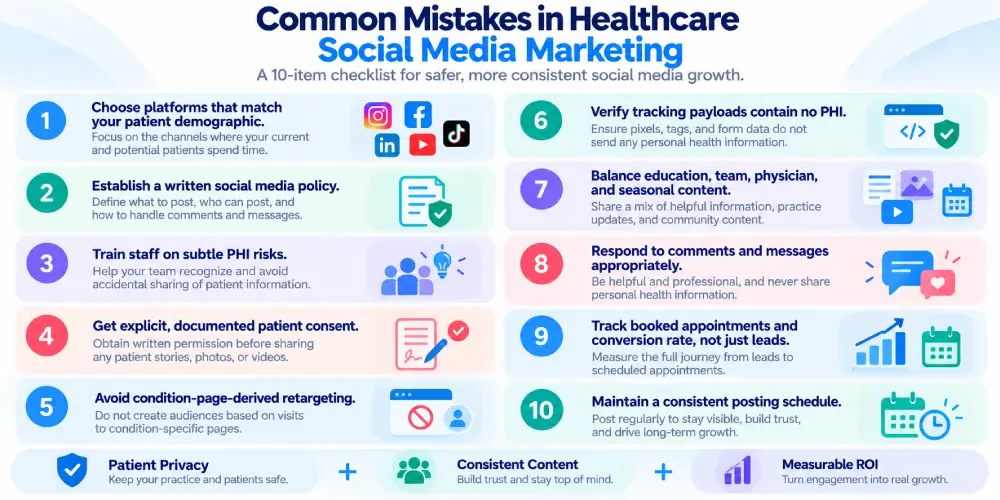
- Identify the one or two platforms that genuinely align with your patient demographic
- Establish a written social media policy covering posting authority and compliance boundaries
- Train all staff on subtler PHI risks, including public comment interactions
- Obtain explicit, documented consent before featuring any patient in content
- Mark your ad account’s Restricted Data Use setting accurately and avoid condition-page-derived retargeting
- Verify server-side tracking payloads carry no PHI before launching any campaign
- Build a content mix balancing education, team culture, physician perspective, and seasonal relevance
- Respond to comments and messages promptly and appropriately
- Track cost per booked appointment and conversion rate by channel, not just cost per lead
- Maintain a consistent, sustainable posting schedule rather than sporadic bursts
Key takeaways
- Choose platforms based on your target patients.
- Focus on educational and trustworthy content.
- Never share patient information without proper consent.
- Follow applicable healthcare advertising and privacy regulations.
- Use videos, testimonials, FAQs, and educational posts to build trust.
- Track leads, inquiries, appointments, and conversions to measure ROI.
A Practical Healthcare Social Media Checklist
- Identify the one or two platforms that genuinely align with your patient demographic
- Establish a written social media policy covering posting authority and compliance boundaries
- Train all staff on subtler PHI risks, including public comment interactions
- Obtain explicit, documented consent before featuring any patient in content
- Mark your ad account’s Restricted Data Use setting accurately and avoid condition-page-derived retargeting
- Verify server-side tracking payloads carry no PHI before launching any campaign
- Build a content mix balancing education, team culture, physician perspective, and seasonal relevance
- Respond to comments and messages promptly and appropriately
- Track cost per booked appointment and conversion rate by channel, not just cost per lead
- Maintain a consistent, sustainable posting schedule rather than sporadic bursts
Where to Start
Our social media marketing team builds campaigns around the compliance framework in this guide from day one, and our paid media service handles the ad configuration and channel-level ROI tracking covered above.