
 Healthcare SEO
 PPC & Google Ads
 Website Design
 Content Marketing
 Reputation Management
Winning the Map Pack for Local SEO for Medical Clinics

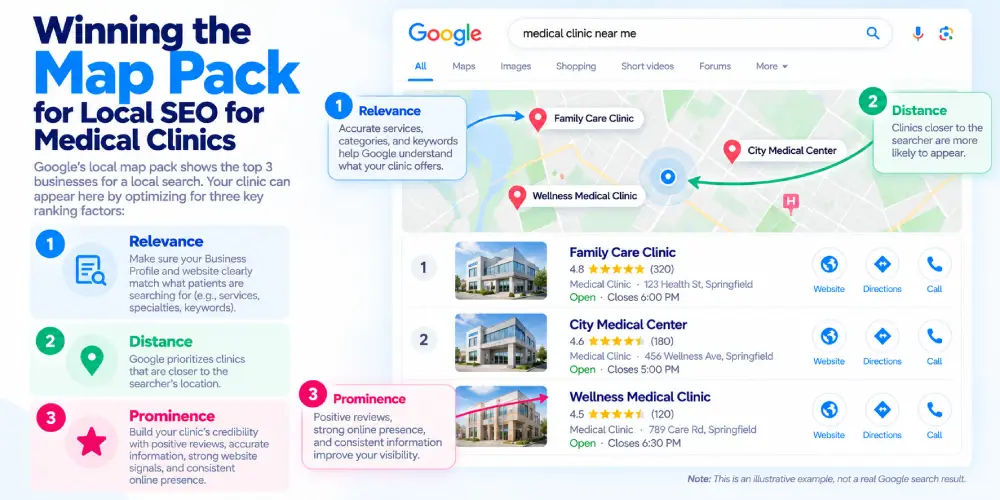
Why the Map Pack Matters So Much for Clinics
The Three Pillars Behind Map Pack Rankings
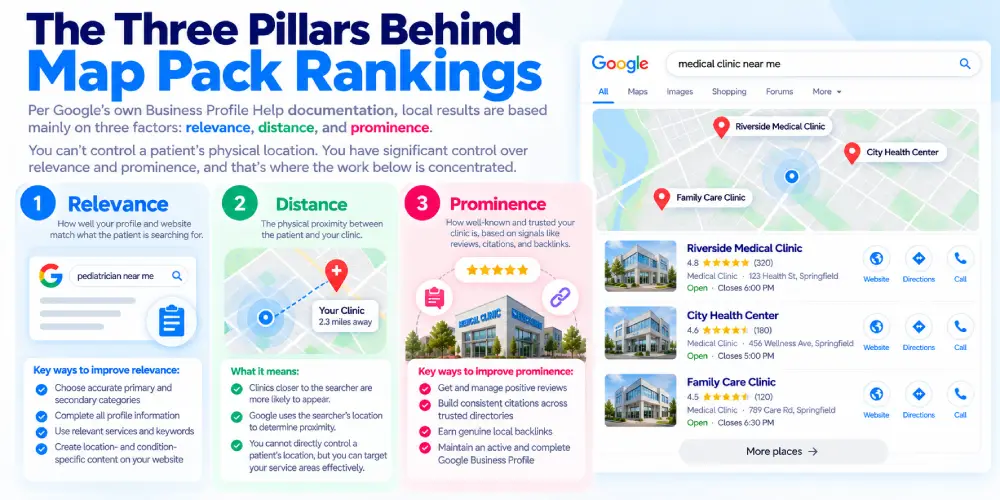
Per Google’s own Business Profile Help documentation, local results are based mainly on three factors: relevance, how well your profile and website match what the patient is searching for; distance, the physical proximity between the patient and your clinic; and prominence, how well-known and trusted your clinic is, based on signals like reviews, citations, and backlinks.
Ten Elements That Win the Map Pack
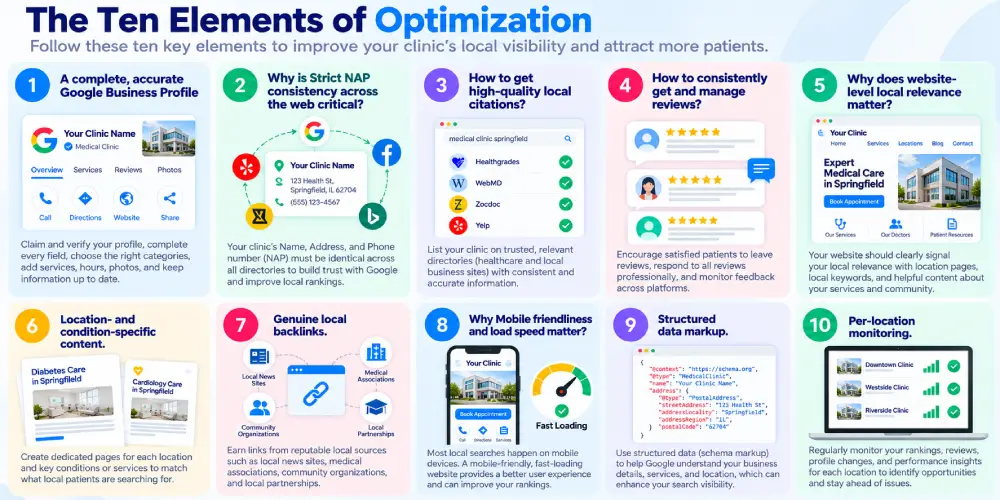
- A complete, accurate Google Business Profile. This is the foundation. Use the primary category that actually matches your clinic, “Urgent Care Clinic” or “Family Practice Physician,” not something broader, and add relevant secondary categories. Fill out every field: hours, accepted insurance where supported, services offered, and a natural, keyword-relevant description. Incomplete profiles consistently underperform complete ones. We cover this in full depth in our guide to Google Business Profile optimization for medical clinics.
- Why is Strict NAP consistency across the web critical? Your clinic’s name, address, and phone number need to appear identically everywhere, your website, your Business Profile, every directory. Small discrepancies, “St.” versus “Street,” an outdated number on an old listing, create conflicting signals that weaken your ranking. Audit this across every platform, correct inconsistencies immediately, and standardize the format going forward.
- How to get high-quality local citations? Citations, mentions of your name, address, and phone number on other sites, are trust signals that help Google verify your clinic is real and located where it says. Prioritize high-authority, healthcare-specific directories, Healthgrades, Zocdoc, Vitals, WebMD’s provider directory, since consumer research on how patients evaluate providers shows these are specifically where patients look when comparing medical practices, more so than general directories. Beyond those, Yelp, Bing Places, and Apple Maps still contribute meaningfully. Quality beats volume here: a handful of accurate citations on reputable, relevant sites outperforms dozens scattered across low-quality directories, and inaccurate citations can actively hurt you by creating conflicting signals.
- How to consistently get and manage reviews? Volume, recency, and quality of reviews all factor into prominence, and consumer research on review behavior confirms recency in particular is something patients weigh heavily when comparing providers. A clinic with a steady stream of recent, detailed reviews typically outranks a competitor with a higher rating but few reviews or a long gap since the last one. Build a simple, repeatable request system, ideally a direct link sent by text shortly after a positive visit, while the experience is fresh. Reviews mentioning a specific condition treated or a physician by name carry more relevance signal than a generic rating alone. Respond to every review, positive and negative; Google’s own guidance on managing customer reviews confirms that a thoughtful response demonstrates accountability and helps build trust with prospective patients reading the rest of your reviews.
- Why does website-level local relevance matter? Your Business Profile carries significant weight, but your actual website matters too. Include your NAP clearly in the footer on every page, and build a dedicated, fully built-out page for each physical location if you operate more than one. Avoid a single generic “locations” table, individual pages with location-specific service information, staff, and even neighborhood-relevant content meaningfully strengthen relevance for each listing. We go deeper on structuring these pages correctly, including the specific technical trap that undermines this approach, in our guide to multi-location SEO.
- Location- and condition-specific content. An article addressing both your city and a specific health topic, where to get a flu shot in your city, choosing an urgent care for a minor injury in your neighborhood, signals topical and geographic relevance at once. It also naturally reflects the conversational, location-aware way patients actually search, both in traditional search and increasingly through AI-powered assistants.
- Genuine local backlinks. Links from community organizations, local news outlets, or neighborhood business associations send real local relevance signals. A sponsored health fair, a school wellness event partnership, or an expert quote in a local news story about a health topic often naturally generates these. Avoid generic, low-quality directory submissions purely for link building, they add little value and can occasionally do more harm than good.
- Why Mobile friendliness and load speed matter? A large share of “doctor near me” searches happen on a phone, often while someone is out and dealing with an urgent concern. A slow or hard-to-navigate mobile site loses patients to a competitor even when you’re ranking well in the map pack itself. Confirm fast load times, clean small-screen display, and a phone number and address that are immediately visible and tappable.
- Structured data markup. LocalBusiness and MedicalClinic schema on your website gives search engines explicit, machine-readable confirmation of your name, address, hours, and services, reinforcing the same information in your Business Profile and citations. This strengthens consistency; it’s a supporting signal, not a shortcut around the fundamentals above.
- Per-location monitoring. For clinics with multiple locations, map pack rankings can vary significantly between neighborhoods. Track how each location ranks for its relevant local searches, and identify sites that need additional citation work, review generation, or content to catch up.
Are there any special considerations in GBP for multi-location clinics?
Each location is effectively competing separately for its own map pack visibility. Every site needs its own individually verified Business Profile, its own dedicated website page, and its own citation-building effort, sharing a single generic listing or page across multiple addresses significantly weakens relevance for each one. Review generation and NAP consistency need to be managed per location too, since even small inconsistencies (a missing suite number, differently formatted hours) between sites create friction that’s easy to overlook at scale. Our full guide to multi-location SEO covers the page architecture and schema side of this in depth.
Common Mistakes That Hurt Local Rankings
- Inconsistent NAP information left on old directories after a move or number change.
- Neglecting review generation until ratings go stale, then running a rushed, unnatural-looking campaign.
- Relying on one generic services page instead of real location-specific content.
- Consolidating multiple locations under a single Business Profile or webpage, which limits visibility across every area actually served.
Key takeaways
- Fully optimize your Google Business Profile.
- Choose the most relevant business categories.
- Keep your name, address, and phone number consistent.
- Encourage genuine patient reviews.
- Respond to reviews professionally.
- Add accurate services, photos, and business information.
- Build relevant local citations and links.
- Keep your profile active and up to date.
A Local SEO Checklist for Clinics
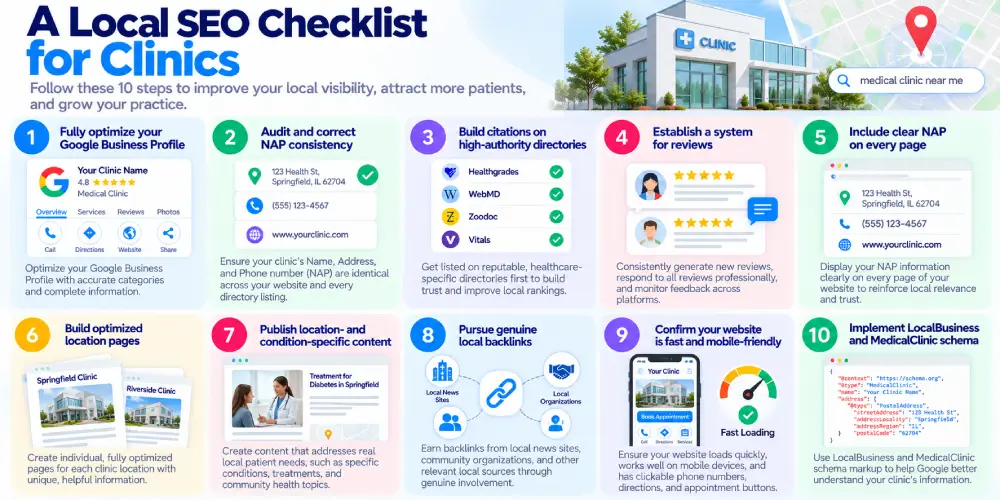
- Fully optimize your Google Business Profile with accurate categories and complete information.
- Audit and correct NAP consistency across your website and every directory listing.
- Build citations on high-authority, healthcare-specific directories first.
- Establish a consistent system for generating and responding to reviews.
- Include clear NAP information on every page of your website.
- Build individual, fully optimized pages for each clinic location.
- Publish location- and condition-specific content addressing real local patient needs.
- Pursue genuine local backlinks through community involvement.
- Confirm your website is fast and mobile-friendly with clickable contact details.
- Implement LocalBusiness and MedicalClinic schema markup.
Further Reading: Choosing Your Local SEO Strategy
This guide covers the tactical work of winning the map pack once you’ve decided local SEO is a priority. If you’re still weighing how to prioritize local SEO against other approaches, two of our other guides cover that strategic decision directly: Local SEO vs. Organic SEO for Healthcare Practices and Local SEO vs. National SEO.
Where to Start
Ready to see exactly where your clinic stands against these fundamentals? Our free SEO audit covers your Business Profile, citations, reviews, and website local-relevance signals together. No cost, no obligation. Request your free audit.
Our local SEO team builds and executes exactly this kind of map pack strategy, and our reputation management service handles the review generation and response work covered above.