
 Healthcare SEO
  PPC & Google Ads
  Website Design
  Content Marketing
 Reputation Management
 Marketing
Local SEO for Multi-Location Clinics: Ranking Strategy That Scales
Expanding a healthcare brand into multiple locations creates a powerful growth engine, but it also introduces a complex SEO challenge that many clinics underestimate. Unlike a single-location practice, where authority is centralized, multi-location clinics must build independent local visibility for each branch while maintaining a consistent and trustworthy brand presence.

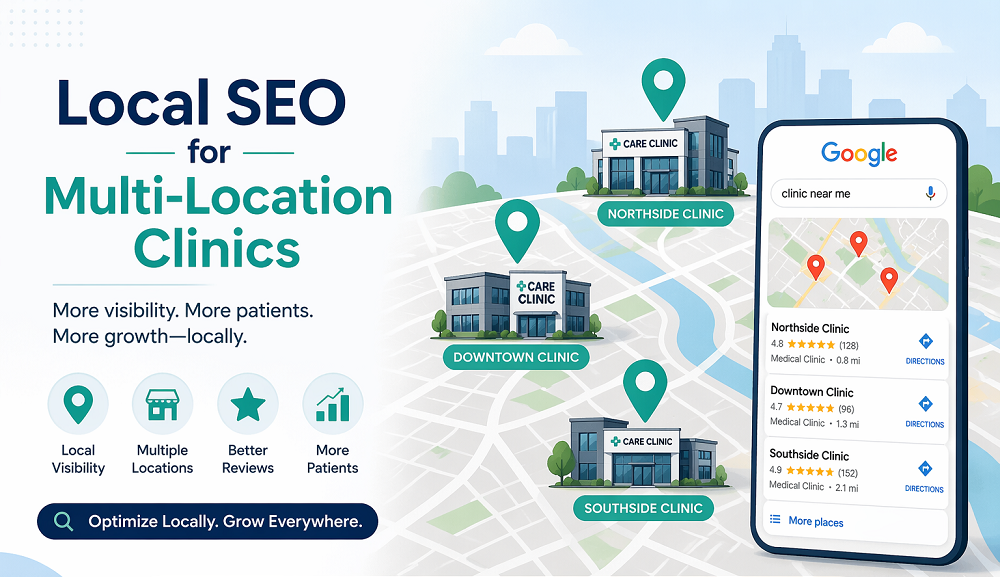
This is where local SEO becomes critical. Without a structured approach, clinics often face issues like duplicate content, inconsistent listings, and weak local rankings, which directly impact patient acquisition.
A well-executed SEO for multiple locations strategy ensures that each clinic appears in local search results, Google Maps, and “near me” queries relevant to its geography. More importantly, it helps healthcare providers meet Google’s EEAT standards (Experience, Expertise, Authoritativeness, Trustworthiness), which are especially important in the medical industry.
In this guide, you will learn how to build a scalable, repeatable multi-location SEO strategy that drives consistent traffic and leads across all your clinics.
Why Local SEO is Critical for Multi-Location Clinics
Key Benefits of Local SEO for Clinics:
- Higher Visibility: Appear in “near me” and city-based searches
- Improved Patient Acquisition: Capture high-intent users
- Stronger Trust Signals: Reviews and ratings build credibility
- Competitive Advantage: Outrank smaller clinics
- Better Conversion Rates: Local traffic converts higher
A dermatology clinic in Austin went from 0 to 50+ qualified patient leads per month through organic content, while reducing Patient Acquisition Cost by 72% over 12 months.
Challenges of SEO for Multiple Locations
Common Challenges:
- Duplicate or thin content
- Inconsistent NAP (Name, Address, Phone)
- Google Business Profile errors
- Uneven review distribution
- Technical SEO complexity
Single Location SEO vs Multi-Location SEO
| Factor | Single Location SEO | Multi-Location SEO |
|---|---|---|
| Strategy Complexity | Low | High |
| Keyword Targeting | Broad + Local | Hyper-local |
| Google Business Profile | One listing | Multiple listings |
| Content | General + Local | Unique per location |
| NAP Management | Simple | Complex |
| Reviews | Centralized | Distributed |
| Technical SEO | Basic | Advanced |
Scalable Local SEO Strategy
A scalable multi-location SEO strategy is built on systems, not manual effort. The goal is to create repeatable processes that maintain quality while allowing growth.
Core Components:
- Location page optimization
- Google Business Profile management
- NAP consistency and citations
- Review management
- Local link building
- Technical SEO infrastructure
Location Pages Optimization
Location pages act as the foundation of your healthcare SEO strategy. These pages must provide real value while signaling relevance to search engines.
Best Practices:
- Unique H1 with city keywords
- Localized service descriptions
- Staff profiles and credentials
- Embedded Google Maps
- Schema markup
Google Business Profile Management at Scale
Each clinic must have its own optimized Google Business Profile. Proper management ensures visibility in maps and local search results.
Optimization Checklist:
- Accurate categories
- Updated hours
- High-quality images
- Regular posts
NAP Consistency and Citations
Consistency in business information is essential. Even small variations can impact rankings and trust.
- Maintain identical details everywhere
- Audit citations regularly
- Use centralized systems
Reviews and Reputation Management
Reviews are critical for rankings and trust. A strong strategy ensures every location builds credibility.
- Automate review requests
- Encourage feedback
- Respond promptly
Local Link Building
Local backlinks improve authority and relevance within geographic areas.
- Community partnerships
- Local sponsorships
- Media coverage
Technical SEO for Multi-Location Sites
- Clean URL structure
- Internal linking
- Mobile optimization
- Fast loading speed
- XML sitemaps
Content Strategy for Each Location
- City-specific blogs
- Seasonal health topics
- FAQs and case studies
Common Mistakes to Avoid
- Duplicate content
- Ignoring local intent
- Inconsistent NAP
- Poor review management
- Over-automation
Tools & Automation for Scaling
- Citation management tools
- Review platforms
- SEO tracking software
- CMS systems
- Stop paying for every single click. Build a content library that earns traffic for free. Get a Free SEO Audit from Sinopia to see where you're currently missing out.
Frequently asked questions
Q1. What is SEO for multiple locations?
Q2. How do I optimize multiple clinic locations?
Q3. Why is local SEO important for healthcare?
Patients search locally, and visibility directly impacts appointments.
Q4. How many reviews do I need?
Q5. Can I duplicate content?
Rahul Sharma is a Digital Marketing Specialist and growth strategist focusing on search engine optimization (SEO), generative engine optimization (GEO), and performance marketing. With expertise in organic search, AI search paradigms (AEO), and automated marketing workflows, Rahul writes for Sinopia on building scalable brands and adapting to modern search discovery patterns. His work bridges technical search foundations, user intent, and practical AI applications to help brands establish long-term visibility, trust, and measurable digital growth.