
Sinopiaus

/
/

How Can Doctors Turn Reviews Into Referrals?

Healthcare Marketing

How Can Doctors Turn Reviews Into Referrals?
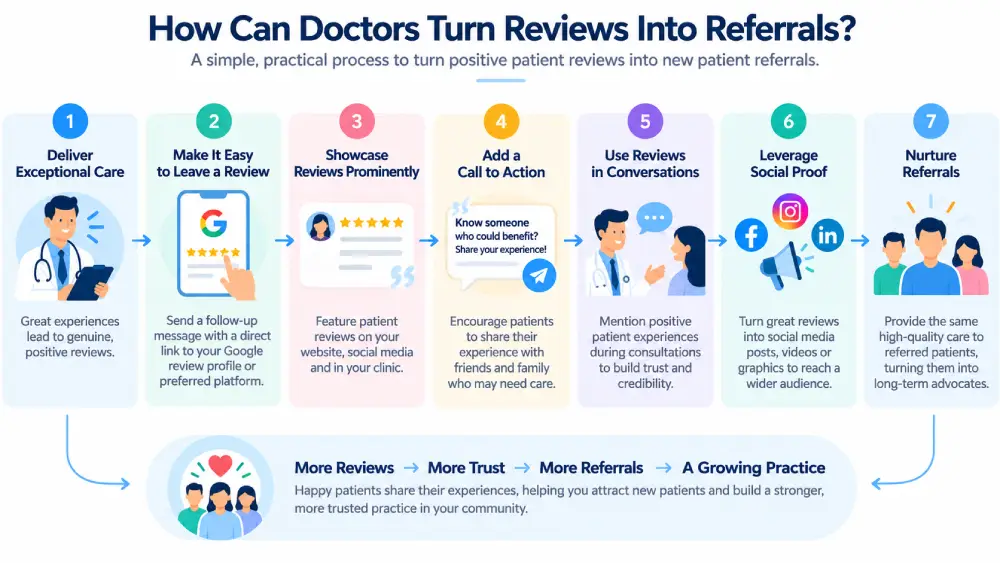
Positive reviews can do more than build trust—they can help doctors generate new patient referrals. When patients share specific, authentic experiences, prospective patients are more likely to feel confident choosing the practice. Doctors can turn reviews into referrals by making it easy for satisfied patients to leave feedback, showcasing genuine testimonials, and encouraging patients to share the practice with friends and family.
From Reviews to Referrals_ A Doctor’s Guide
The short answer
Make positive patient experiences visible and easy to share. Encourage satisfied patients to leave reviews, highlight meaningful feedback across your website and social media, and include simple referral prompts after successful visits.
A patient deciding between two equally qualified doctors will almost always choose the one with stronger, more recent online reviews. That’s simply how healthcare decisions get made today. Before anyone books an appointment, they check Google reviews, browse Healthgrades, and read patient testimonials looking for reassurance they’re making the right choice. For a medical practice, reputation management isn’t optional public relations work anymore. It’s a core driver of new patient growth.
This guide covers how reputation management for doctors actually works: generating reviews ethically, responding to them the right way, and turning everyday patient satisfaction into a steady stream of referrals, on the platforms that carry real weight in healthcare and increasingly in AI search results too.

Why Reputation Matters More in Healthcare

Choosing a doctor is a higher-stakes decision than choosing a restaurant. Patients are trusting someone with something deeply personal, which means they research more thoroughly and weigh reviews more heavily than in almost any other industry. A strong reputation doesn’t just affect where a practice ranks in search. It directly shapes whether a prospective patient feels safe enough to book that first appointment at all.
Reviews carry weight beyond individual decisions too. Search engines factor review volume, recency, and rating into local pack rankings, and, as covered in more detail later in this guide, AI-powered search tools increasingly reference review content when deciding which providers to mention in generated answers. Reputation management now supports SEO, AEO, and GEO performance simultaneously, not just patient perception.
What the Data Shows
Research shows that patients increasingly rely on online reviews when choosing a doctor. Positive, detailed reviews build trust, reduce uncertainty, and can influence prospective patients to book an appointment or recommend the practice to others.

Understanding the Key Platforms

  • Google Reviews remain the single most influential platform for most practices, appearing directly in the local map pack and heavily influencing local rankings. A steady stream of recent, detailed reviews is often the strongest lever available for both visibility and conversion. We cover the full mechanics of this in our guide to Google Business Profile optimization.
  • Healthgrades functions differently from general review platforms, built specifically around healthcare providers and often ranking prominently for a physician’s name directly. Many patients treat it as a more clinically focused source than general platforms, which makes an accurate, actively managed profile there particularly important.
  • Vitals, Zocdoc, and WebMD’s provider directory also contribute to overall reputation, and keeping consistent, accurate profiles across all of them reinforces the same trust signals search engines and patients both rely on.
  • Social media and Facebook reviews matter less centrally to healthcare than to industries like hospitality, but they still count, particularly for practices with an active social presence where patients are already engaging.

How to Build a System for Generating Reviews?

Reputation management fails most often not because a practice lacks satisfied patients, but because it lacks a consistent system for asking them. Waiting passively for reviews to accumulate almost always results in a slow, inconsistent flow that doesn’t keep pace with actual patient volume.
  • Ask at the right moment. The best time to request a review is immediately after a positive interaction, while the experience is still fresh, right after a successful appointment or a particularly helpful front-desk interaction.
  • Make it effortless. Friction is the biggest obstacle here. A direct link sent by text or email that takes a patient straight to the review form, rather than requiring them to search for your practice themselves, dramatically increases completion rates. Many practices automate this to trigger shortly after an appointment is marked complete.
  • Train staff to support it. A brief, natural mention at checkout that feedback helps other patients find the right care, paired with a follow-up text, consistently outperforms relying on digital requests alone.
  • Never incentivize or selectively request reviews. Offering incentives for reviews, or asking only patients you suspect will leave positive feedback, violates the terms of service for most review platforms and creates real ethical and legal exposure in a healthcare context. We cover Google’s specific policy on this, including the real restrictions it can place on a profile for violations, in our Google Business Profile guide. Every patient should have an equal, unfiltered opportunity to leave feedback.

What is the Best Way to Respond to Reviews?
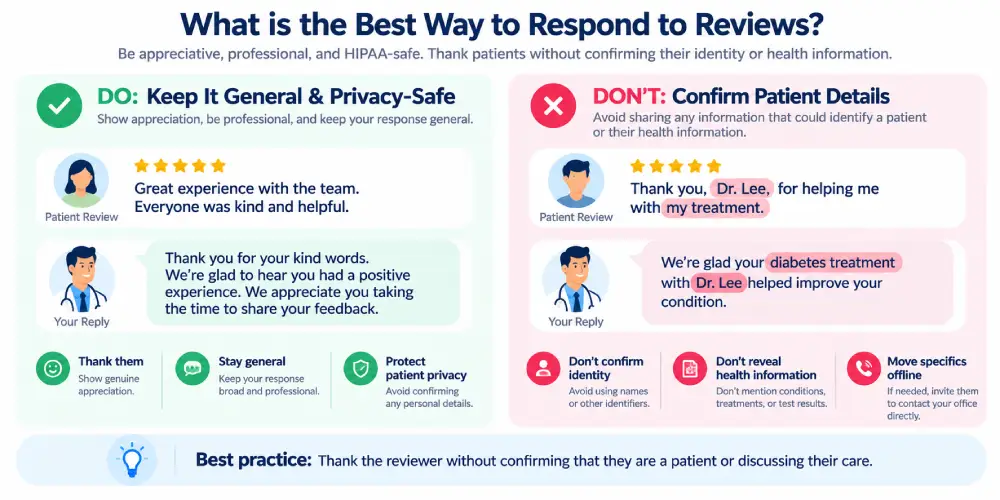
Generating reviews is only half of this. How a practice responds to both positive and negative feedback matters just as much to the trust of prospective patients reading it.
A brief, genuine thank-you on a positive review, mentioning specific details where appropriate, reads as more authentic than a generic templated reply. A thoughtful, professional response to a negative review, acknowledging the concern without defensiveness and inviting the patient to reach out directly, demonstrates accountability without escalating anything publicly.

One thing worth stating plainly: never disclose specific patient health information in a public response, even if the patient disclosed it themselves. This can create a real HIPAA violation regardless of intent, and it has carried real financial penalties in OCR enforcement actions, covered in depth in the review-response section of our Google Business Profile guide. Keep replies general and professional, and move anything specific to a private channel.

Turning Reviews Into Referrals

Strong reviews do more than build passive trust. Used thoughtfully across a practice’s broader marketing, they actively generate new patient referrals.
  • Feature reviews on your website, particularly on relevant service pages and physician bio pages, reinforcing trust at the exact moment a prospective patient is deciding whether to book. Reviews mentioning a specific condition or physician by name carry particular weight, reinforcing both patient confidence and topical relevance.
  • Share standout testimonials on social media, with patient permission where appropriate, extending their reach to existing followers who may refer friends or family with similar concerns.
  • Attach physician-specific reviews directly to that provider’s bio page, rather than pooling everything at the practice level, a more personal, persuasive signal for a patient specifically researching that individual doctor. We cover the full anatomy of an effective bio page in our guide to physician website design.
  • Rotate a brief testimonial into your patient newsletter, reinforcing confidence and prompting existing patients to mention the practice to others.

Does Reputation Now Extend to AI Search Results?
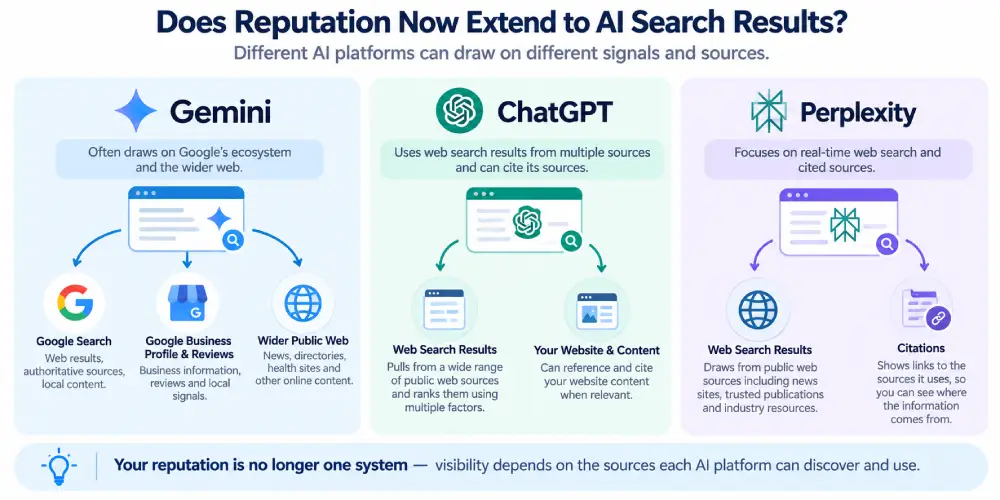
AI Search Reputation Signals
Everything above used to be a human trust and traditional SEO conversation. It’s now also an AI-visibility one, and it’s worth understanding precisely how, since the mechanics genuinely differ by platform.
  • Gemini and Google’s AI features draw heavily on your Google Business Profile and review data, directly via the Grounding with Google Maps mechanism we cover in our GBP guide. A complete profile with active, detailed reviews feeds these answers the same way it feeds the local pack.
  • ChatGPT works differently, and this matters. It doesn’t have direct access to Google Reviews or your Business Profile. On July 23, 2026, OpenAI and Yelp announced a formal non-exclusive data-licensing agreement giving ChatGPT direct access to 330 million cumulative Yelp reviews and 8+ million business listings, with Yelp branding and links displayed in ChatGPT’s answers, plus integration of Yelp’s “Request a Quote” feature directly into ChatGPT’s local search results. One industry analysis examining several million AI citations found that roughly half of ChatGPT’s local citations trace back to third-party review sites rather than Google directly. This is directional industry research rather than a confirmed platform rule, but the underlying implication holds: a reputation footprint concentrated only on Google may leave gaps.
  • Perplexity draws significantly on Yelp and community sources, which is another reason the multi-platform citation building already covered in this guide- Healthgrades, Vitals, Yelp, WebMD- isn’t just about human-facing trust and traditional local rankings anymore. It’s literally part of what different AI systems retrieve when constructing an answer to a patient’s direct question.
One specific, practical implication worth acting on: the level of detail in a review matters to what an AI system can actually extract and cite. A review noting a specific condition treated or a specific outcome gives these systems something concrete to work with. A generic five-star rating with no detail gives them nothing to extract. This is a direct reason, beyond the SEO relevance already covered, to encourage patients to describe their actual experience rather than just rate it.
For the fuller picture of how each AI platform’s citation mechanics work, see our guides to answer engine optimization and generative engine optimization.

Monitoring Consistently and Handling a Reputation Crisis

Reputation management isn’t a one-time project. Regularly monitor Google, Healthgrades, and other relevant platforms, responding promptly rather than letting feedback, especially negative feedback, sit unanswered. Many practices use reputation management software that consolidates reviews from multiple platforms into a single dashboard, making consistent monitoring realistic without manually checking each site.
If a cluster of negative reviews appears, whether due to a genuine service issue, a misunderstanding, or, occasionally, coordinated bad-faith activity, resist responding defensively or arguing publicly. Address any underlying issues directly if they exist, respond to each review professionally and consistently, and focus on generating additional genuine positive reviews to help balance the picture over time. If a review clearly violates a platform’s guidelines, most platforms provide a formal flagging process, though removal is never guaranteed and can take time.

A Practical Reputation Management Checklist
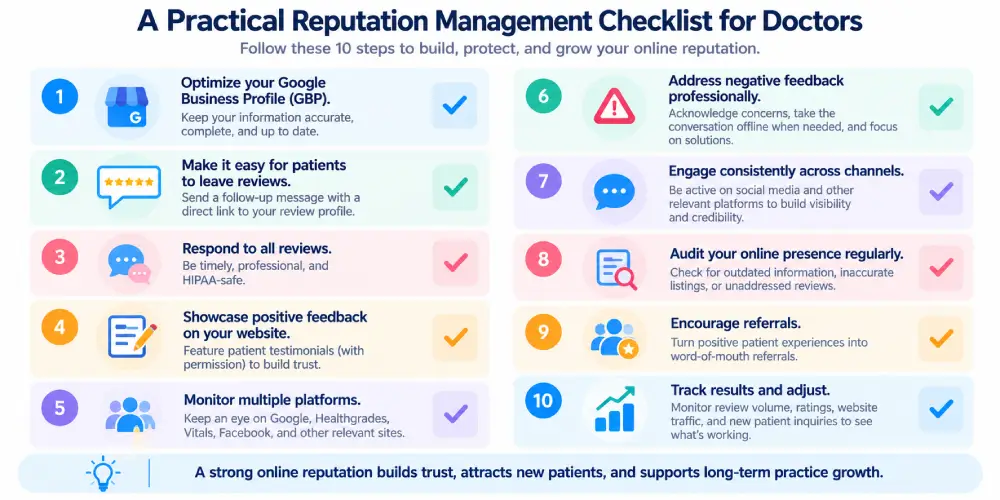
Doctor Reputation Management Checklist
  1. Build a consistent system for requesting reviews shortly after positive interactions
  2. Make the review process frictionless with direct links
  3. Train front desk and clinical staff to naturally encourage feedback
  4. Never incentivize reviews or selectively request feedback based on expected sentiment
  5. Respond to every review, positive and negative, professionally and promptly
  6. Never disclose patient health information in a public review response
  7. Feature genuine testimonials on your website and physician bio pages
  8. Monitor Healthgrades and other healthcare-specific platforms alongside Google
  9. Encourage reviews that mention specific conditions or outcomes, not just a star rating
  10. Use reputation management software to consolidate monitoring across platforms

Key takeaways

Common Mistakes in Reputation Management

  • Inconsistent review requesting, enthusiastic for a few weeks, then abandoned
  • Failing to respond to negative reviews at all, which reads as dismissive to future readers
  • Neglecting Healthgrades and other healthcare-specific platforms in favor of Google alone
  • Disclosing specific patient details in a public response, even when trying to correct the record

Where to Start

Reputation management for doctors isn’t a peripheral marketing task anymore. It shapes local search visibility, patient trust, referral growth, and increasingly, whether an AI system recommends you at all when a patient asks a direct question instead of typing a search query. Build a consistent system for generating reviews, respond thoughtfully across every platform that matters, not just Google, and feature genuine testimonials throughout your website and marketing.

Ready to see exactly where your reputation stands, and where the real gaps are? Our free SEO audit covers your review generation, response consistency, and platform coverage across both traditional and AI search. No cost, no obligation. Request your free audit.

Our reputation management service builds and runs exactly this kind of system, and our healthcare SEO team ties it back to your broader search and AI visibility strategy.

Frequently Asked Questions

Q1. How many reviews does a practice need to rank well locally?

There’s no fixed number. Consistent, recent reviews matter more than a single large batch acquired all at once, since ongoing activity signals sustained engagement to both search engines and prospective patients.

Q2. Is it legal to respond to a negative review that mentions specific treatment details?

You can and should respond, but the response must avoid confirming or disclosing any patient health information, even if the patient included those details themselves.

Q3. Can negative reviews actually be removed?

Sometimes, if a review violates platform guidelines or clearly wasn’t left by an actual patient, it can be flagged for removal, though this isn’t guaranteed and can take time.

Q4. Does Healthgrades really matter if my Google reviews are strong?

Yes. Healthgrades often ranks prominently for searches involving a physician’s name directly, worth actively managing alongside Google rather than treating as an afterthought.

Q5. Does my reputation actually affect whether AI tools like ChatGPT recommend me?

Yes, though the mechanics differ by platform. Google’s AI features draw on your Business Profile directly. ChatGPT and Perplexity lean more on third-party platforms like Yelp and Healthgrades, which is another reason a multi-platform reputation strategy matters now, not just for humans reading reviews, but for what these systems can find and cite.

Q6. How quickly should a practice respond to a new review?

Ideally within a few days. Prompt responses demonstrate active engagement and give prospective patients confidence the practice is attentive.
About the authors
Prem Kasera is a seasoned digital marketing strategist, performance marketer, and writer specializing in search engine optimization (SEO), answer engine optimization (AEO), and generative engine optimization (GEO). With over 20 years of experience driving growth across e-commerce, healthcare, and agency environments, Prem crafts insight-driven articles and blogs on Sinopia. His writing focuses on technical SEO, content cluster frameworks, paid media strategy, and navigating AI search paradigms to help brands build measurable visibility and authority.

Ready to Grow Your Practice?

Schedule a free consultation with our healthcare marketing experts to uncover hidden opportunities for patient growth. No commitment required.