
 Healthcare SEO
  PPC & Google Ads
  Website Design
  Content Marketing
 Reputation Management
 How Google Updates Affect Strategies for FAQPage Schema for Medical Websites


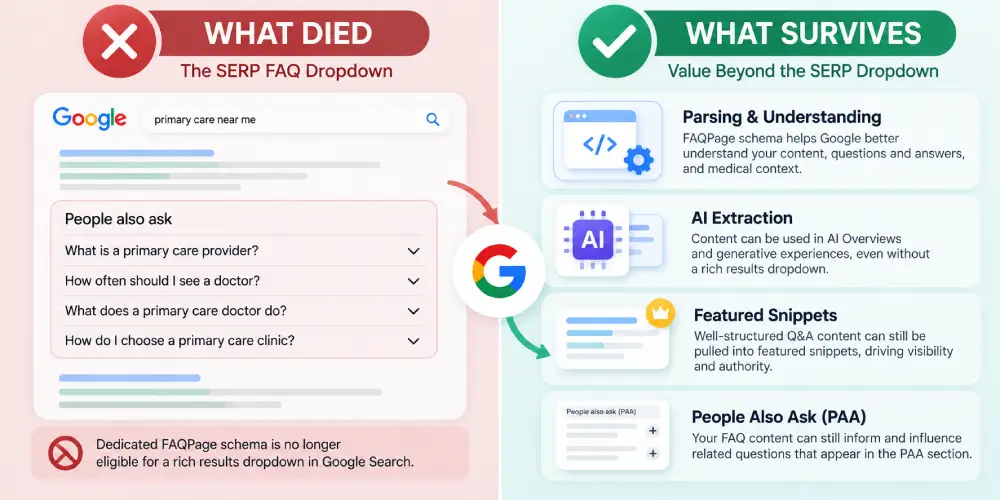
FAQ rich results stopped appearing in Google Search on May 7, 2026, for every website, including the government and health sites that had kept them the longest. These FAQ rich results used to appear as a dropdown of expandable questions and answers under the search listings. It is important to note that the FAQPage remains a valid schema type, and Google continues to parse it to understand pages. This means that the real value of an FAQ strategy for a medical practice now runs through AI citation, featured snippets, and genuine patient experience, not a dropdown that no longer exists.
If that first paragraph surprises you, you’re not alone. Most content about FAQ schema is now out of date, and some of it is actively misleading. This guide covers what actually happened, what survives per Google’s own documentation, and what a medical practice’s FAQ strategy should look like now.
What Google Changed for FAQPage Schema?
August 2023: Google announced on its Search Central blog that FAQ rich results would only be shown for well-known, authoritative government and health websites. For everyone else, the dropdown effectively vanished. For nearly three years, medical and health sites were among the only sites on the web still eligible, which is why FAQ schema remained a genuinely useful visibility play for healthcare specifically, long after it stopped mattering for most industries.
May 7, 2026: Google deprecated the feature entirely. The notice sits directly on Google’s FAQ structured data documentation: FAQ rich results no longer appear in Google Search for any site, the FAQ search appearance filter, rich result report, and Rich Results Test support are being removed in June 2026, and Search Console API support follows in August 2026. The narrow health-site eligibility that survived 2023 is gone too.
Google published no separate explanatory blog post for the 2026 change, just the documentation notice. Which means anyone still selling FAQ schema as a way to win expandable search results, four months after the feature stopped existing, either hasn’t checked or is hoping you haven’t. That’s worth remembering the next time an agency pitch mentions rich results; it’s exactly the kind of currency test we describe in our guide to choosing a healthcare SEO, AEO and GEO agency.
What Does Not Change per Google in FAQPage Schema?
1. FAQPage remains a valid schema.org type.
2. Existing markup doesn't need to be removed.
3. Google continues to use FAQ structured data to understand pages.
That third point deserves accurate framing, consistent with what Google says about structured data and AI features generally: per its AI features documentation, no special schema is required for AI Overviews or AI Mode, and structured data is not a separate AI pathway. FAQPage markup helps systems parse your content correctly. It is not, and never really was, a visibility shortcut. What made FAQ content valuable was always the content itself.
Why FAQ Content Matters More Than FAQ Markup for Medical Websites?
Key takeaways
- Don’t use FAQPage schema solely to chase FAQ rich results.
- Keep FAQ questions and answers visible to users on the page.
- Use valid FAQPage, Question, and Answer structured data.
- Avoid marking up promotional or misleading FAQ content.
- Keep medical answers accurate, concise, and expert-reviewed.
- Don’t assume valid schema guarantees a rich result.
- Validate markup with Google’s Rich Results Test and monitor Search Console.
- Focus on helpful patient content first and structured data second.
- Update your schema strategy as Google’s structured-data guidelines change.
Why Sourcing Real Patient Questions is the Best Strategy for FAQPage Schema?
- Front desk calls: the questions people ask before booking (insurance, referrals, wait times, what a first visit involves)
- Patient portal messages: the questions people ask between visits, often symptom- and logistics-related
- Intake forms and appointment questions: what patients want to know going into a specific procedure or treatment
- The exam room itself: the questions physicians answer over and over, which are exactly the questions the next patient is typing into a search bar or asking an AI assistant
Writing Answers That Get Extracted and Cited
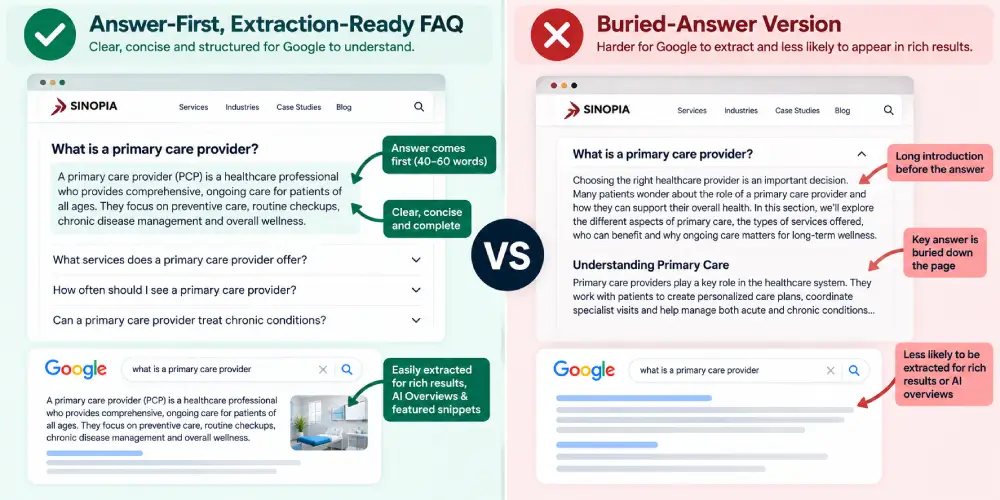
- Answer first. The direct answer belongs in the first sentence, with nuance and context after. An answer that spends three sentences warming up before answering is harder for a patient to use and harder for an AI system to extract.
- Make each answer self-contained. It should make sense lifted out of the page entirely, no “as mentioned above,” no dependence on surrounding context, because that’s exactly how extraction works.
- One question, one answer block. Don’t chain multiple questions into one sprawling response.
- Put a credentialed reviewer behind anything clinical. Any answer touching symptoms, treatments, or medications should be written or reviewed by a clinician, with a named medical reviewer line. This is the same YMYL standard that governs all medical content, and an FAQ answer is not exempt from it just because it’s short.
- Keep answers honest about uncertainty. “It depends, and here’s what it depends on” is a better answer, for patients and for citation, than false precision.
Implementing the Markup, With Accurate Expectations
- Mark up only content that is actually visible on the page
- Use FAQPage only for questions with a single authoritative answer provided by the site itself. Pages where users submit their own answers are a different type (QAPage), and conflating them is a common implementation error
- Keep the markup synchronized with the visible content when answers get updated
One practical note on validation: with FAQ support being removed from the Rich Results Test in June 2026, validate your JSON-LD syntax with the schema.org definition and a general structured-data validator rather than expecting FAQ-specific feedback from Google’s tooling going forward.
Where FAQs Should Live on a Medical Website
- Service and condition pages first. Questions attached to the page a patient is already evaluating (“How long is recovery from this procedure?” on the procedure’s own page) carry booking intent and topical relevance at once. This beats routing everything to a standalone mega-FAQ page that competes with nothing and supports nothing.
- Location pages for logistics questions: parking, insurance accepted at that site, walk-in policies.
- Blog posts, where a closing FAQ block extends the article’s coverage into adjacent questions, the pattern we use across our own content.
- A general practice FAQ page still has a role for practice-wide questions (billing, records requests, portal help), just not as the only home for every question on the site.
Common Mistakes to Avoid
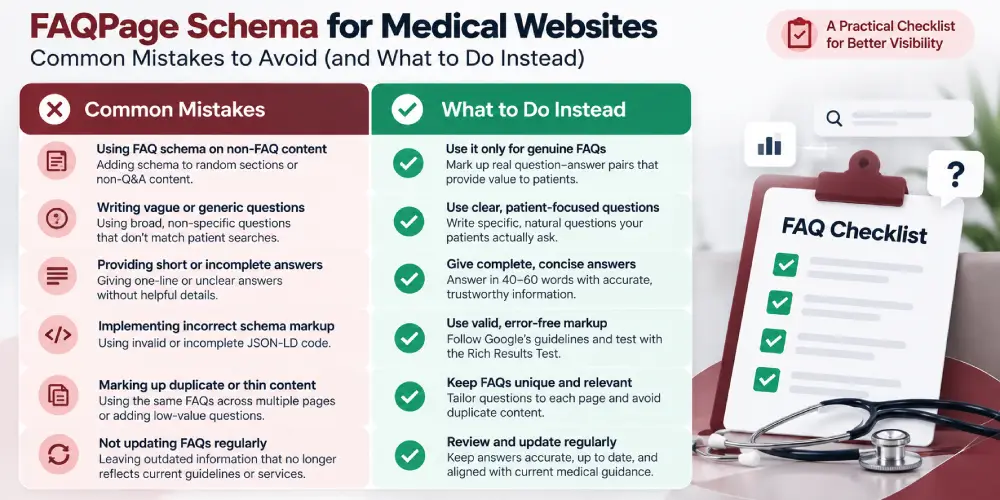
- Chasing the dead rich result, or paying anyone who’s still selling it. The feature ended in May 2026; strategy built on it is four months out of date at minimum.
- Bolting generic FAQ blocks onto every page. Mass-produced, low-value FAQ markup is the exact abuse pattern that got the rich result restricted in 2023 in the first place. Volume without genuine usefulness was never the strategy.
- Marking up content that isn’t visible on the page, still against Google’s guidelines, and pointless besides.
- Skipping clinical review on symptom and treatment answers. Short format doesn’t lower the accuracy bar for health content; if anything, a confidently wrong two-sentence answer is worse than a hedged long one.
- Writing answers for extraction at the expense of honesty. An answer optimized to sound definitive that overstates certainty is a liability in a YMYL category, not an optimization.
Where to Start
Want to know whether your schema and FAQ content are aligned with how search works now? Our free SEO audit covers your structured data implementation, content structure, and AI-extraction readiness together. No cost, no obligation. Request your free audit.