Sinopiaus

/
/
Healthcare SEO, AEO & GEO Agency vs. General SEO Agency..
Healthcare Marketing

Healthcare SEO, AEO & GEO Agency vs. General SEO Agency: What's the Difference?

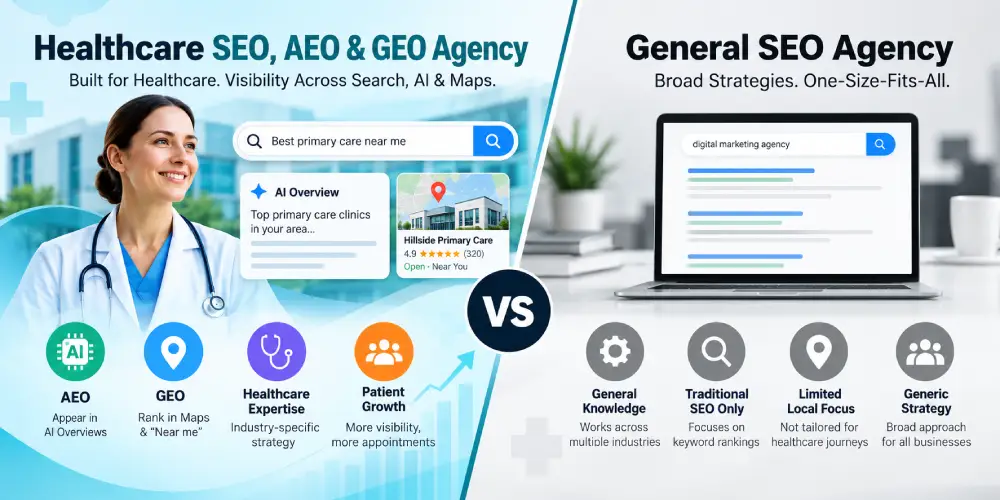
A healthcare SEO, AEO, and GEO agency focuses specifically on how patients discover medical information across traditional search engines and AI-powered platforms. Unlike a general SEO agency, it combines healthcare expertise, medical accuracy, local search optimization, and AI-focused content strategies.
Healthcare SEO vs General SEO Agencies
The short answer
A general SEO agency primarily works to improve traditional search rankings and organic traffic. A healthcare-focused SEO, AEO, and GEO agency goes further by optimizing medical content for Google Search, answer engines, AI Overviews, and generative AI platforms. It also accounts for healthcare-specific requirements such as medical accuracy, E-E-A-T, patient search intent, local visibility, and credible sourcing.
A general SEO agency optimizes a website to attract traffic. A healthcare-specific agency has to do that while working inside three constraints most general agencies never encounter: the higher content-quality bar Google applies to health topics, the HIPAA rules that reshape the entire marketing-technology stack, and the newer mechanics of getting cited accurately by AI answer engines. Miss any one of those, and a campaign that looks fine on a traffic chart can quietly create compliance risk or fail to convert a single patient.
This guide explains exactly where those differences live, verified against Google’s and HHS’s own documentation rather than agency marketing claims, so you can tell a genuine healthcare specialist from a generalist with a healthcare slide in the deck.

Why Healthcare Search Is Held to a Higher Standard

Google doesn’t evaluate all content the same way. In its guidance on creating helpful, people-first content, Google explains that its systems give more weight to strong expertise and trustworthiness signals for topics that could significantly affect a person’s health, financial stability, or safety, what it calls “Your Money or Your Life” (YMYL) topics. Health content sits squarely in that category.

The framework Google’s human quality raters use to evaluate this is E-E-A-T: Experience, Expertise, Authoritativeness, and Trustworthiness, defined in Google’s publicly available Search Quality Rater Guidelines. One important nuance, and a good early test of whether an agency actually understands this: E-E-A-T is an evaluation framework, not a direct ranking lever. Raters don’t score your individual pages into the algorithm. What the guidelines describe is the quality target Google’s ranking systems are tuned toward, which is why aligning with them matters even though no single “E-E-A-T score” exists. An agency that promises to “boost your E-E-A-T score” doesn’t understand the thing it’s selling.

The practical consequence: the shortcuts that work in lower-stakes verticals, thin content, unreviewed claims, generic writing with no credentialed author, actively work against a healthcare site. We cover this foundation in depth in our guides to SEO for doctors and answer engine optimization.
Why the difference matters in healthcare
Healthcare search involves high-trust, often high-stakes information. Patients may now discover providers and medical information through traditional Google results, AI-generated answers, voice searches, and conversational AI tools. Healthcare-focused optimization therefore needs to make content accurate, well-structured, authoritative, locally relevant, and easy for both search engines and AI systems to understand and reference.

The Four Differences between Healthcare-Specific vs. General Marketing Agencies
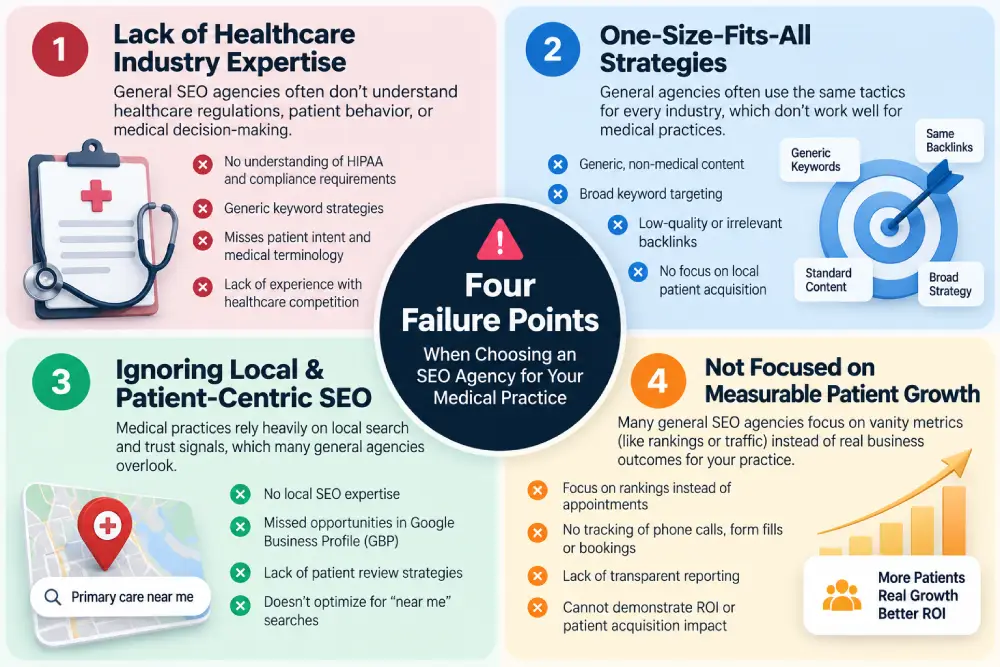
Four SEO Failure Points for Medical Practices
The difference between a healthcare agency and a general one is most evident in four specific areas.

1. Do they understand what creates PHI exposure risk?

This is the failure point with real legal consequences, and the one general agencies are least equipped to see. A standard analytics and advertising setup, Google Analytics, Meta Pixel, third-party chat widgets, most generic form handlers, can transmit identifiable health information to third parties without anyone intending it to. A healthcare-specific agency will have specific technical solutions to de-risk PHI exposure.

Per HHS’s HIPAA Privacy Rule, identifiable health information is protected regardless of how it’s collected, and HHS/OCR issued specific guidance on online tracking technologies addressing exactly this risk on healthcare websites. A general agency that installs its standard tracking stack on a patient portal page or a condition-specific landing page may be creating a disclosure for which the practice is liable. A healthcare agency configures the entire stack around this constraint from the start. We cover the full technical picture, including how the regulatory guidance has evolved, in our guide to what makes a website HIPAA compliant.

2. How do AI Citations Work in AEO and GEO Platforms?

Patients increasingly get answers from AI systems, Google’s AI Overviews, ChatGPT, Perplexity, before ever reaching a website. Getting cited accurately by these systems is its own discipline, and one where a lot of misinformation circulates. A healthcare agency worth hiring knows what Google actually says here: per Google’s documentation on AI features and its guide to optimizing for generative AI, there’s no special markup or separate technical track required; it’s the same content quality and technical soundness, applied well. An agency selling “AI optimization” as a separate mysterious product is selling something Google has explicitly said doesn’t exist. We cover what actually works in our guides to answer engine optimization and generative engine optimization.

3. Is Compliance Baked into Local GMB Optimization?

Local search is where most practices get their patients, but healthcare local SEO carries constraints a general agency won’t know to handle. Google’s local ranking factors, relevance, distance, and prominence — apply to everyone, but the way a medical practice handles reviews is governed by both HIPAA and Google’s own Prohibited and Restricted Content policy. Responding to a patient review the wrong way can breach patient privacy; asking for reviews the wrong way can violate Google’s policy. A general agency optimizing a clinic’s profile the way it optimizes a restaurant’s is walking into both risks. We cover this in our guides to Google Business Profile optimization and reputation management for doctors.

4. How to Build Practice Provider Credibility?

Health content needs a credentialed, verifiable author behind it, exactly the Experience and Expertise signals the E-E-A-T framework describes. A general agency’s default of anonymous, marketer-written content signals low trust for a YMYL topic, no matter how polished the writing is. A healthcare agency builds provider bio pages, credential visibility, and named authorship as a core part of the strategy, not an afterthought. We break down what that actually looks like in our guide to physician website design.

Comparing Your Options: Agency, In-House, or Hybrid
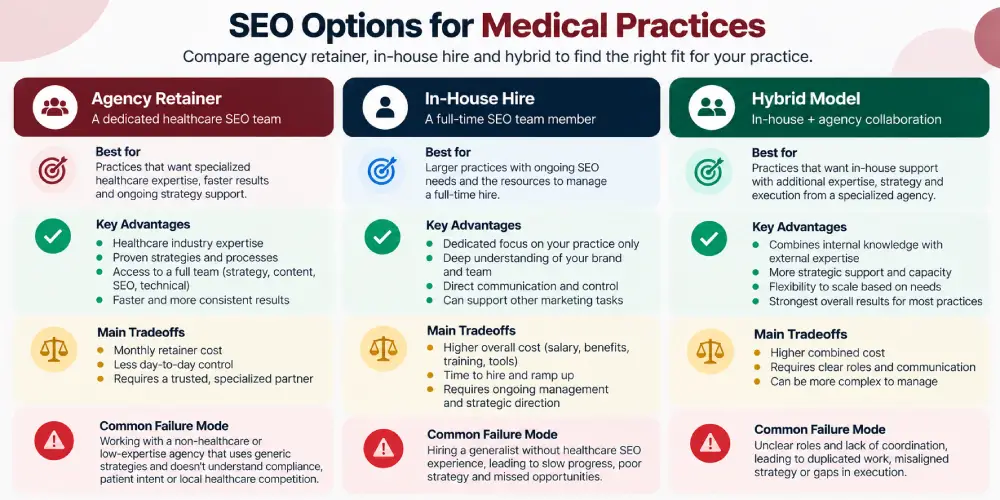
SEO Options for Medical Practices
A specialized agency isn’t the only way to solve this. There are really three models, each with a different tradeoff:
  • A healthcare-specialized agency on retainer gives you immediate execution capacity and exposure to patterns learned across many similar practices, without the overhead of hiring. The failure mode to watch for: a generalist account team where the “healthcare expertise” lives in the sales deck but not in the people doing the actual work.
  • An in-house SEO hire gives you dedicated, always-available ownership, but concentrates all the expertise in one person, and a single hire rarely covers the full range (technical, content, local, compliance, AI) that healthcare SEO actually requires.
  • A hybrid or fractional model, keeping some functions in-house (social posting, patient photography) while an agency handles technical and compliance-sensitive work, often fits growing practices well.
Cost varies widely by scope, market, and practice size, and any specific figure depends entirely on what’s actually included, so the more useful question than “what does it cost” is “what am I actually paying for, and does whoever I hire genuinely understand the four areas above.” Our healthcare SEO service is built specifically around them.

Questions That Actually Reveal the Difference
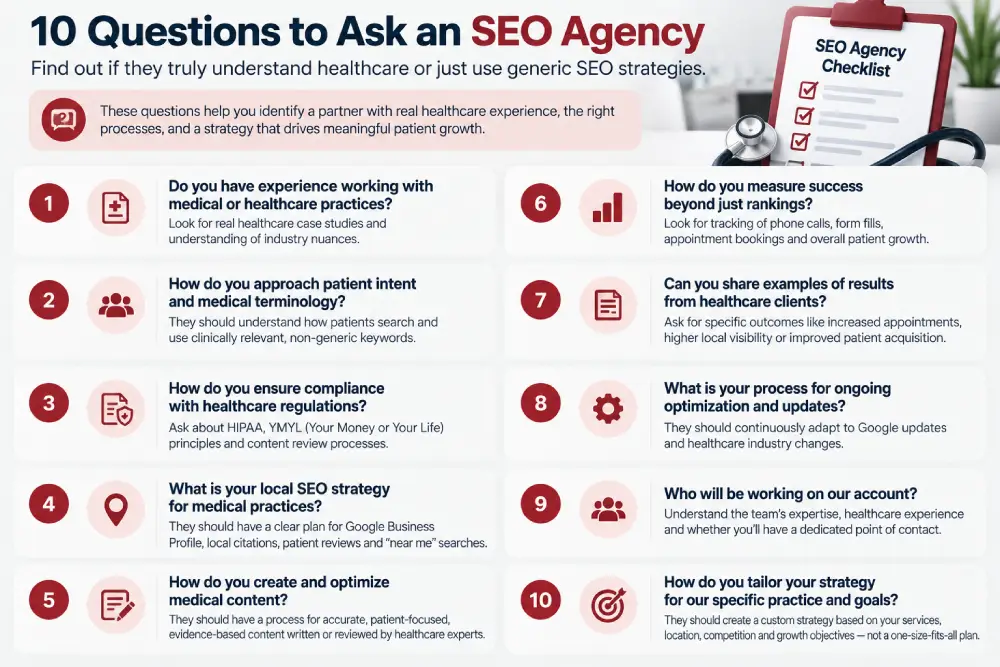
Healthcare SEO Agency Checklist_infographic
When evaluating any agency, these questions separate genuine healthcare specialists from generalists:
  • How do you configure analytics and advertising tracking to avoid transmitting PHI to third parties?
  • Who writes and reviews our clinical content, and how is authorship and credentialing handled on the site?
  • How does your approach to reviews and Google Business Profile account for HIPAA specifically?
  • What do you actually do for AI search visibility, and what does Google say is required for it?
  • Can you show measurable patient-acquisition results, booked appointments or qualified inquiries, not just traffic charts?
An agency that answers these with specificity and confidence understands the environment. One that gives generic marketing answers likely hasn’t worked in it closely.

Key takeaways

Where to Start

The honest test of a healthcare SEO, AEO, and GEO agency isn’t how impressive its results charts look. It’s whether it can speak specifically to the four areas above: PHI-safe marketing technology, credentialed content, compliance-aware local optimization, and accurate AI-citation structuring, because those are the places a generalist quietly gets a medical practice into trouble.

Want to see how your current setup measures against these standards? Our SEO/AEO audit reviews your technical, content, local, and compliance fundamentals, including whether your current tracking stack poses any PHI exposure risk. No cost, no obligation. Request your free audit.

Learn more about our approach on our healthcare SEO page.

Frequently Asked Questions

Q1. How is SEO used in healthcare?

It helps a practice appear when patients search for symptoms, conditions, treatments, providers, and “near me” queries, then structures the site to convert those searches into booked appointments, all while meeting the higher content-quality and privacy standards health content requires.

Q2. What does a healthcare SEO agency actually do?

Technical SEO, provider and service-line page optimization, local SEO and Google Business Profile management, review strategy, content built to E-E-A-T standards, AEO/GEO structuring for AI visibility, and, critically, configuring the whole marketing-tech stack to stay HIPAA-compliant. The goal is qualified patient inquiries, not traffic for its own sake.

Q3. How much does healthcare SEO cost?

It varies widely by scope, market competitiveness, and practice size, so a single number rarely means much without that context. The more useful framing is to get a clear breakdown of exactly what’s included, and to weigh it against the alternative models (in-house hire, hybrid) rather than on price alone.

Q4. Is healthcare SEO really different from regular SEO?

Yes. The core mechanics overlap, but health content is held to Google’s stricter YMYL quality standards, and HIPAA reshapes what tracking, forms, and review practices are even permissible. A general agency applying its standard playbook can create real compliance risk without realizing it.
About the authors
Prem Kasera is a seasoned digital marketing strategist, performance marketer, and writer specializing in search engine optimization (SEO), answer engine optimization (AEO), and generative engine optimization (GEO). With over 20 years of experience driving growth across e-commerce, healthcare, and agency environments, Prem crafts insight-driven articles and blogs on Sinopia. His writing focuses on technical SEO, content cluster frameworks, paid media strategy, and navigating AI search paradigms to help brands build measurable visibility and authority.

Ready to Grow Your Practice?

Schedule a free consultation with our healthcare marketing experts to uncover hidden opportunities for patient growth. No commitment required.